Introduction
When a loved one has been cremated, families may wish to carry or send the cremated remains to another country for a memorial service, burial, or placement in a family’s final resting place. Although cremated remains are often simpler to transport than a body, international travel still involves important practical, legal, and airline-related requirements.
The process can be emotionally difficult, especially when relatives are managing arrangements from different countries. Understanding the major steps in advance can make the journey more predictable and help prevent avoidable delays at the airport or border.
This guide explains how to transport cremated remains internationally by air, with a focus on preparation, documentation, airline coordination, security screening, and destination-country requirements. Rules differ by country and airline, so families should confirm current instructions before making travel arrangements.
Can Cremated Remains Be Transported by Air?
In many situations, cremated remains may travel by air either with a passenger or as an air cargo shipment. However, permission to travel through airport security does not automatically mean that the remains meet the requirements of the airline, departure country, transit countries, or final destination.
There are usually two transportation options:
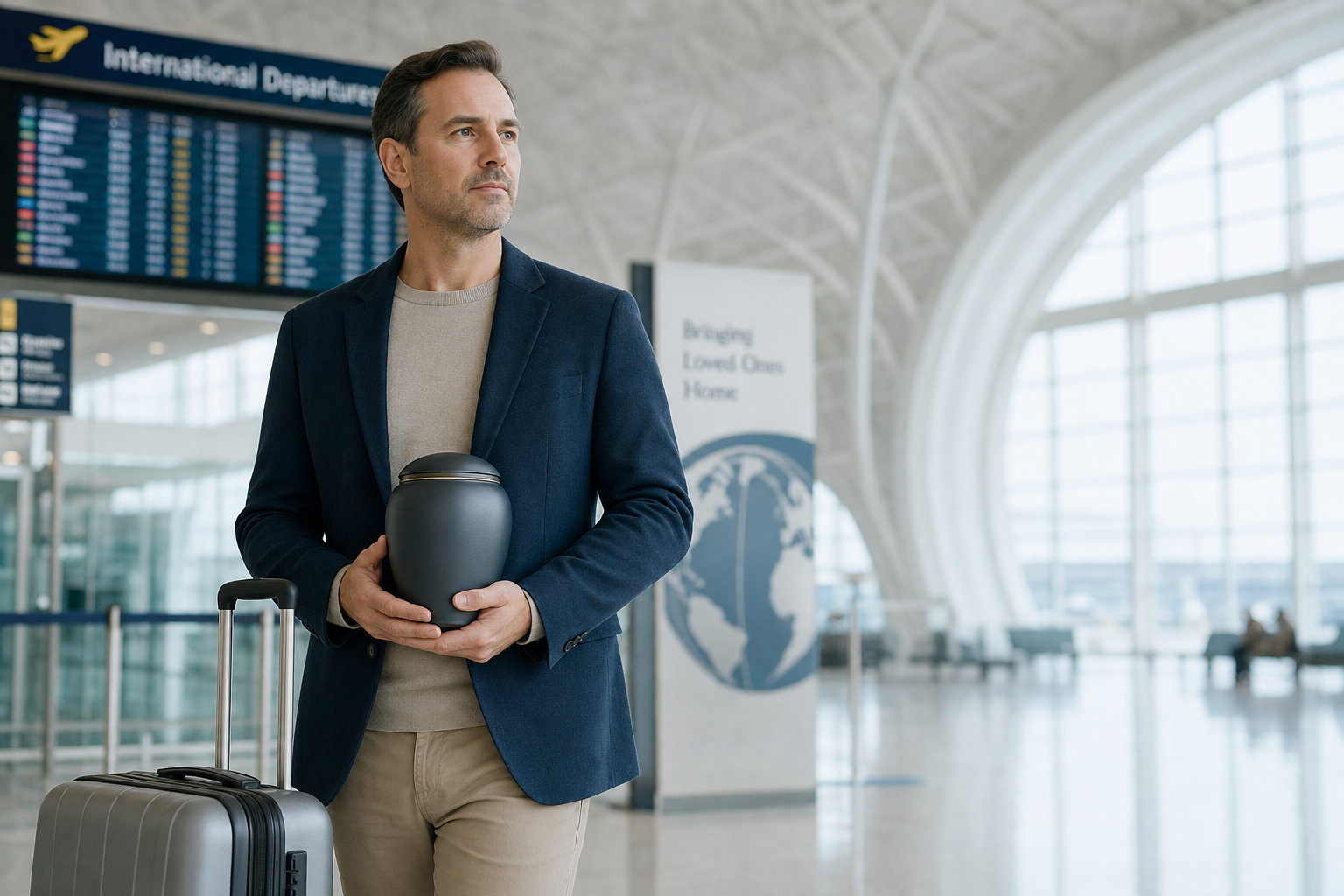
- Passenger travel: A family member carries the urn in cabin baggage or, where permitted, places it in checked baggage.
- Specialized shipment: A funeral home or repatriation provider arranges transportation through an airline cargo department or an approved logistics channel.
For many families, carrying the urn personally may feel more reassuring. A professional shipment may be more practical when relatives cannot travel, when the itinerary is complex, or when the destination requires formal import documentation.
Choose an Urn That Can Pass Security Screening
One of the most common problems during air travel is an urn that cannot be clearly examined by an X-ray machine. The Transportation Security Administration advises travelers to use a temporary or permanent crematory container made from a lightweight material such as wood or plastic. Containers made from materials that create an opaque image may not be accepted through the checkpoint. TSA officers also state that they will not open a cremation container, even at a passenger’s request. ([tsa.gov](https://www.tsa.gov/travel/security-screening/whatcanibring/all-list?pubDate=20250608&utm_source=openai))
For this reason, families should consider using:
- A temporary container made of plastic, wood, cardboard, or another security-friendly material.
- An urn with a secure closure that is not overly bulky.
- A decorative outer urn for use after arrival, if the permanent urn is unsuitable for screening.
Before travel, ask the crematory whether the temporary container is designed for air transport. Avoid placing the container inside wrapping or packaging that makes inspection difficult. A discreet protective case may be used, provided it does not prevent the urn from being screened.
Confirm the Airline’s Policy Before Booking
Airline policies can vary significantly. Some carriers permit cremated remains in carry-on baggage, while others may impose restrictions on checked baggage or require advance notification. TSA lists cremated remains as permitted in both carry-on and checked baggage with special instructions, but it specifically advises passengers to check with their airline because some airlines do not allow cremated remains in checked bags. ([tsa.gov](https://www.tsa.gov/travel/security-screening/whatcanibring/all-list?pubDate=20250608&utm_source=openai))
Contact every airline involved in the itinerary, including carriers operating connecting flights. Ask about:
- Whether the urn may be carried in the cabin.
- Whether advance approval or notification is required.
- Any limits on size, weight, or packaging.
- Rules for checked baggage and cargo shipments.
- Procedures for connecting flights and overnight airport transfers.
- Documents that must be presented at check-in.
It is wise to request the airline’s instructions in writing and keep a copy with the travel documents. Policies may differ even when the same airline operates both the departing and connecting flights.
Prepare the Required Documents
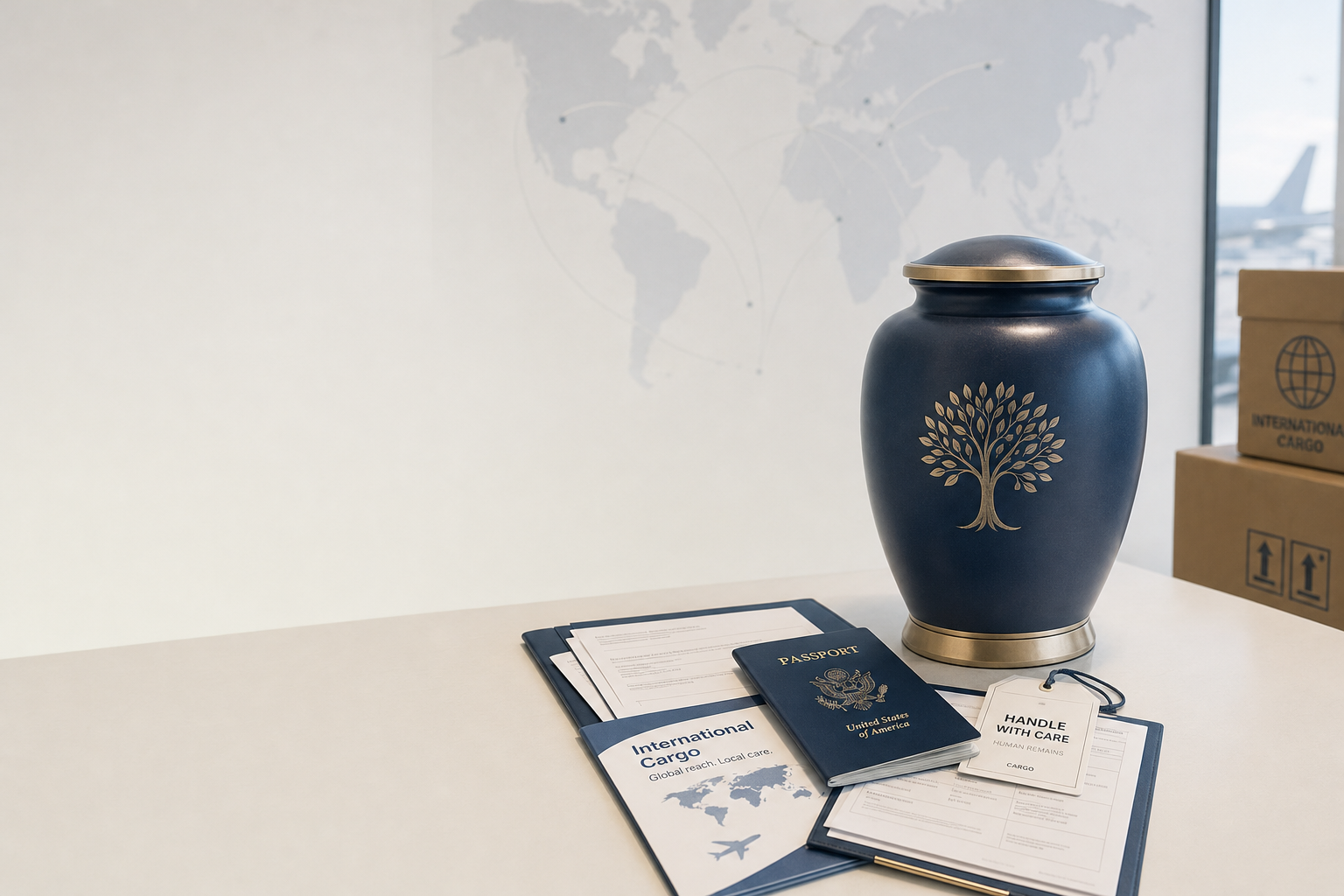
Documentation requirements depend on the countries involved, the citizenship of the deceased, the airline, and whether the remains are carried personally or shipped as cargo. Commonly requested documents may include:
- Certified copy of the death certificate.
- Cremation certificate or cremation permit.
- Certificate from the crematory confirming that the urn contains cremated remains.
- Transit permit or export authorization, where required.
- Import authorization or entry approval from the destination country, where required.
- Identification documents for the person traveling with the urn.
- Certified translations or document authentication, if requested by the destination authorities.
These are general examples, not a universal checklist. The U.S. Customs and Border Protection explains that international shipments of cremated remains may require a death certificate, cremation permit, and additional export or embassy paperwork. ([help.cbp.gov](https://www.help.cbp.gov/s/article/Article-1404?language=en_US&utm_source=openai))
Families should contact the destination country’s embassy or consulate, the relevant health authority, and the airline before departure. Some countries may require documents to be legalized, apostilled, translated, or issued within a specific period.
Understand Transit and Customs Requirements
An international itinerary may involve more than the rules of the departure and destination countries. If the flight connects through a third country, that country may have its own requirements for the temporary entry or transit of cremated remains.
Do not assume that a connection is merely an airport transfer with no legal implications. Ask whether the remains will remain airside, whether they must be formally declared, and whether additional paperwork is needed for transit. A professional repatriation coordinator can help review the route and identify documentation concerns before tickets or cargo space are confirmed.
When entering the United States, CBP notes that remains cremated before entry generally do not require the same import documentation as noncremated human remains. However, airlines and foreign authorities may still require documents for export, transit, or acceptance for carriage. ([help.cbp.gov](https://www.help.cbp.gov/s/article/Article-1404?language=en_US&utm_source=openai))
Carrying the Urn Through the Airport
Arrive early and allow additional time for check-in and security screening. Keep the urn accessible rather than placing it deep inside a tightly packed suitcase. Carry the original documents in a separate folder and keep digital copies as a backup.
At the checkpoint:
- Tell the TSA officer or airport security officer that you are carrying cremated remains.
- Place the urn in a position where it can be examined by X-ray.
- Do not seal the container in a way that prevents required screening.
- Remain calm if additional screening is requested.
- Ask the airline or airport staff for assistance if the route includes a connection.
Security personnel are trained to handle sensitive situations professionally, but procedures can vary outside the United States. A security-friendly container is one of the best ways to reduce uncertainty.
Common Mistakes Families Should Avoid
Several preventable issues can complicate international transport:
- Using a metal, stone, or lead-lined urn that cannot be clearly scanned.
- Checking the urn without confirming the airline’s baggage policy.
- Booking a route before reviewing transit-country requirements.
- Carrying photocopies when certified originals are required.
- Failing to obtain translations or authentication for foreign-language documents.
- Assuming that requirements for one destination apply to every country.
- Leaving the arrangements until the day of departure.
When timing is important, begin planning as soon as the cremation date is known. Government offices, consulates, airlines, and crematories may each have different processing times.
Frequently Asked Questions
Can cremated remains go in carry-on baggage?
Often, yes. TSA permits cremated remains in carry-on baggage with special instructions, but the container must be suitable for X-ray screening. The airline and destination country may impose additional requirements. ([tsa.gov](https://www.tsa.gov/travel/security-screening/whatcanibring/all-list?pubDate=20250608&utm_source=openai))
Can cremated remains be placed in checked baggage?
Some airlines allow this, while others do not. Confirm the policy directly with the operating airline before travel. Carrying the urn in the cabin may provide greater control over its handling, when permitted.
Do I need a death certificate to travel with cremated remains?
Many authorities and airlines request a death certificate and cremation documentation, but requirements differ. For an international shipment, additional export, import, consular, or transit documents may be necessary.
What if the permanent urn cannot pass through security?
A temporary security-friendly container can often be used for the flight, with the remains transferred to the permanent urn after arrival. Confirm the safest approach with the crematory and airline.
Conclusion
Transporting cremated remains internationally by air is possible in many circumstances, but successful travel depends on preparation. The urn must be suitable for screening, the airline’s policy should be confirmed in advance, and every country on the itinerary may need to be considered.
Because requirements change and vary between jurisdictions, families should verify the current rules with the airline, embassy or consulate, customs authority, and relevant local officials. Careful planning helps protect the dignity of the deceased and gives families greater peace of mind during an already difficult time.