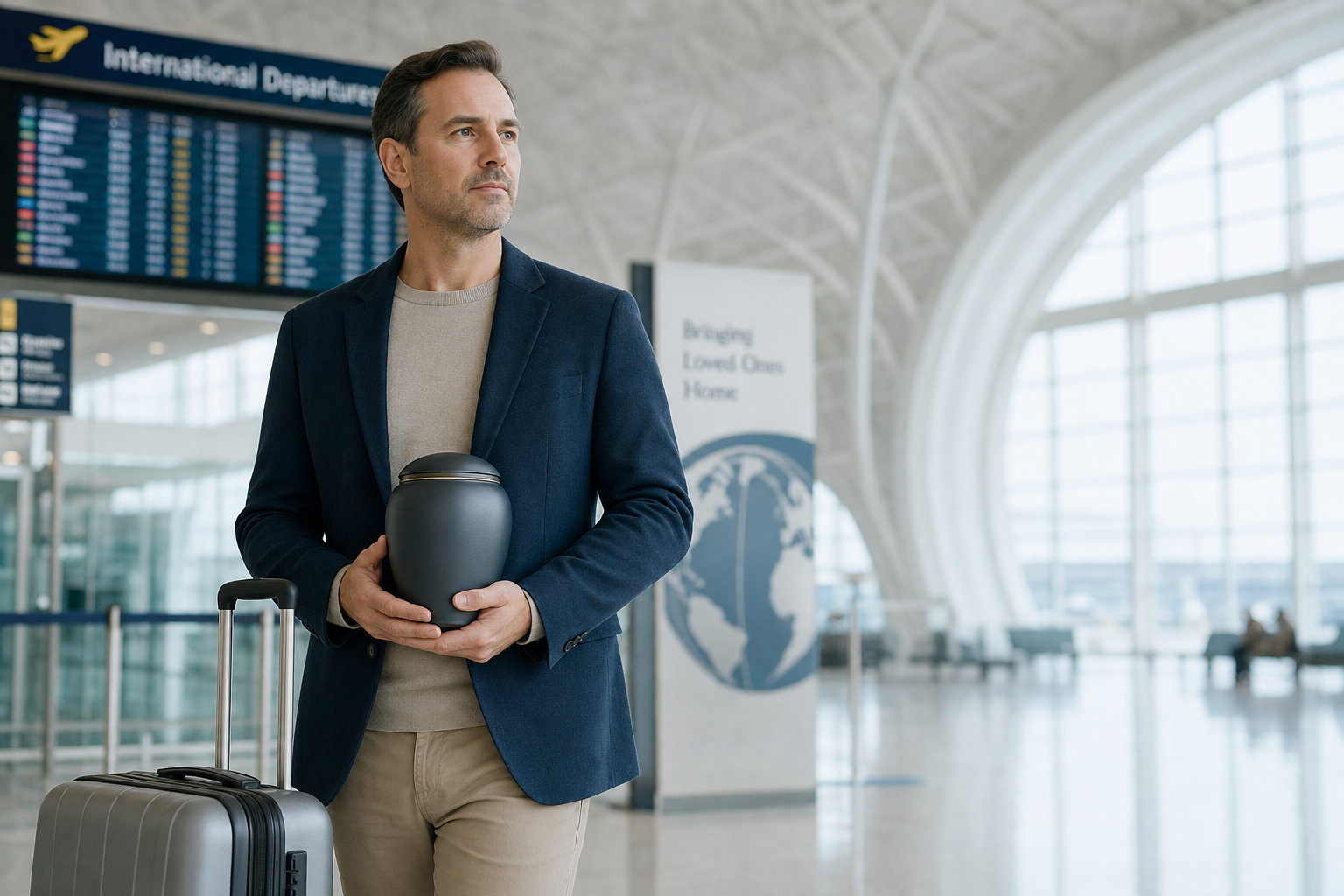
When a loved one is cremated abroad, families may choose to bring the ashes home or send them to another country for a memorial service, burial, or permanent placement. Although transporting cremated remains is often simpler than moving a body, international repatriation of ashes still involves documentation, airline policies, customs procedures, and country-specific requirements.
Understanding the process early can reduce delays and help families make arrangements with greater confidence. Requirements vary depending on the country where the cremation took place, the destination country, the airline, and any transit locations. Always confirm current instructions with the relevant authorities, consulate, funeral professional, and airline before travel.
What Is International Repatriation of Ashes?
International repatriation of ashes is the organized movement of cremated remains across national borders. The ashes may travel as accompanied baggage with a family member, as air cargo arranged through a funeral professional, or through a specialized repatriation provider.
The appropriate method depends on the family’s circumstances and the rules of the countries involved. Some families prefer to accompany the urn on a scheduled flight, while others choose professional cargo handling when they cannot travel themselves or when the destination requires formal shipment.
Unlike a conventional parcel, cremated remains require respectful handling and may need official documentation proving the identity of the deceased, the fact of cremation, and the lawful transfer of the remains.
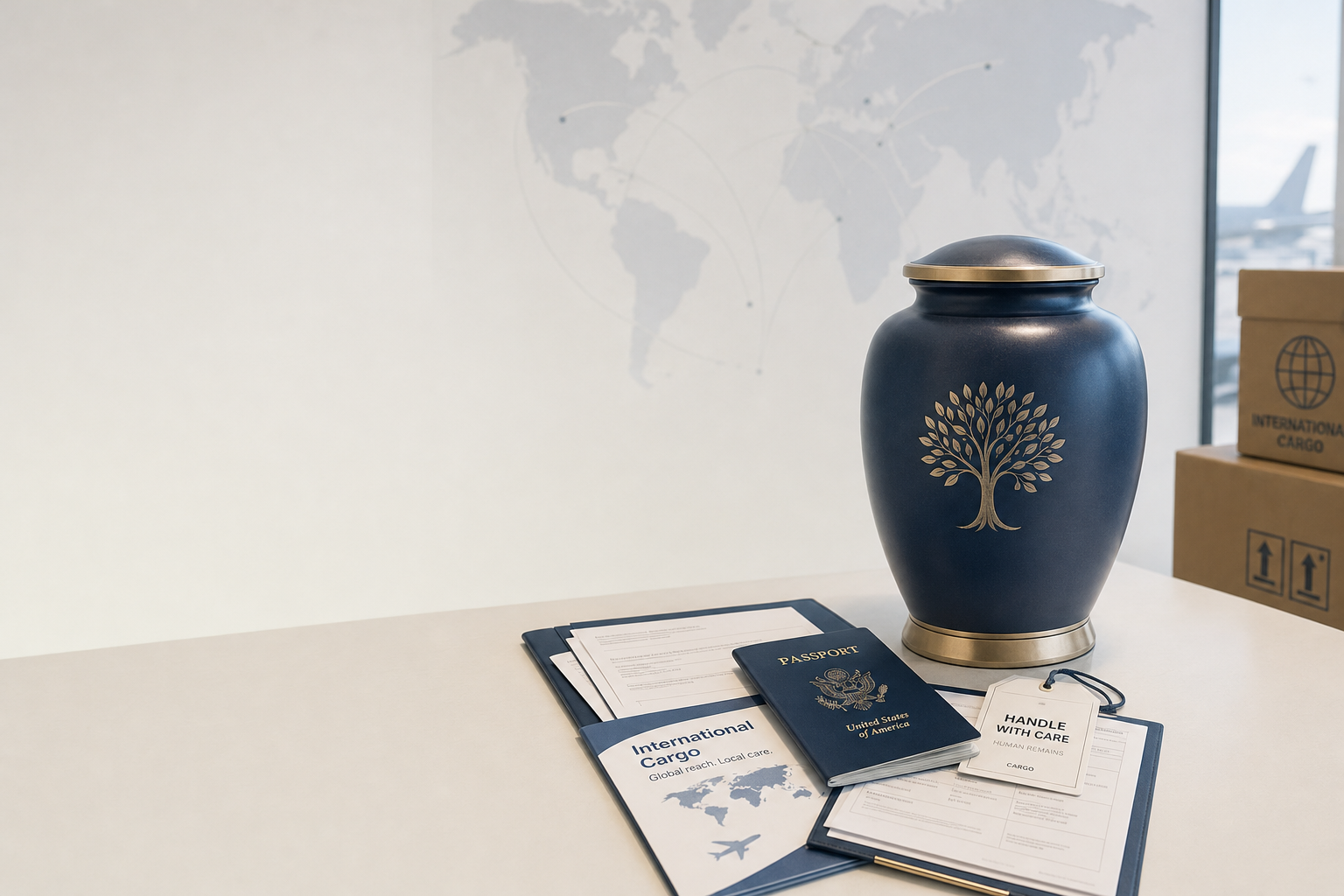
Documents Families May Need
There is no single worldwide document checklist. Exporting and importing authorities may request different paperwork, and documents may need translation, notarization, authentication, or an apostille.
Commonly requested documents can include:
- Certified copy of the death certificate
- Cremation certificate or certificate of cremation
- Certificate identifying the contents of the urn
- Certificate of disposition or local authorization for removal
- Transit permit, export permit, or customs declaration
- Authorization from the next of kin or legal representative
- Passport or identification documents for the traveler
- Import approval or destination-country documentation, where applicable
For a U.S. citizen who dies abroad, the U.S. Department of State explains that consular officers can help families understand local procedures and coordinate with authorities, but the family or estate remains responsible for transportation expenses. The Department also notes that burial or cremation must comply with both U.S. and foreign law. ([travel.state.gov](https://travel.state.gov/content/travel/en/international-travel/while-abroad/death-abroad1.htmlwhile-abroad.html?utm_source=openai))
Families should request several certified copies of the death certificate and cremation certificate. It is also wise to keep digital scans separate from the originals, while carrying the original documents in a secure document wallet.
Choosing an Appropriate Urn
The urn is both a memorial container and a transport item. It must protect the ashes while allowing airport security personnel to complete any required screening.
For air travel from the United States, the Transportation Security Administration permits cremated remains in carry-on and checked baggage, subject to screening and other conditions. TSA advises using a temporary or permanent container made from a material that can be clearly viewed by an X-ray machine. Containers that create an opaque image may not be accepted, and TSA officers will not open an urn during screening. ([tsa.gov](https://www.tsa.gov/travel/security-screening/whatcanibring/all-list?pubDate=20250608&utm_source=openai))
Families should consider a temporary container made from wood, plastic, or another scan-friendly material, especially if the permanent urn is metal, stone, ceramic, or otherwise difficult to examine. The permanent urn can sometimes be placed inside approved protective packaging or transferred after arrival, depending on the destination’s rules and the family’s wishes.
Airline and Airport Considerations
Airport security approval does not automatically mean an airline will accept an urn in a particular way. Airlines may impose their own requirements for carry-on dimensions, checked baggage, advance notice, cargo bookings, or supporting documents. Some airlines may not permit cremated remains in checked baggage.
Before booking travel, contact every airline involved in the itinerary, including codeshare and connecting carriers. Ask specifically about:
- Whether the urn may travel in the cabin
- Whether checked baggage is permitted
- Whether advance arrangements are required
- What documents must be presented at check-in
- Whether the urn must be sealed or labeled in a particular way
- Whether transit through a third country creates additional requirements
The International Air Transport Association explains that airline acceptance and documentation requirements for human remains are not universally identical. Its guidance emphasizes the importance of current country rules, airline instructions, packaging, labeling, and complete documentation. ([iata.org](https://www.iata.org/en/publications/manuals/compassionate-transportation-manual/?utm_source=openai))
Customs and Border Procedures
At the destination, customs officials may ask to review the urn and accompanying paperwork. The traveler should be prepared to declare the cremated remains and explain their purpose, such as transport for a funeral, interment, or family custody.
Do not place important documents inside the urn or permanently seal paperwork with the ashes. Keep all certificates accessible in a separate folder. If the urn is inspected, officials should be able to confirm its contents without unnecessary disruption.
For entry into the United States, the CDC states that fully cremated remains generally do not require a CDC import permit. Its guidance also distinguishes cremated remains from non-cremated human remains for certain public-health and container requirements. However, this does not eliminate foreign export rules, airline policies, customs declarations, or documentation requested by local authorities. ([cdc.gov](https://www.cdc.gov/importation/human-remains/index.html?utm_source=openai))
When Professional Assistance May Help
Professional assistance can be valuable when the family is not traveling, the cremation occurred in a country with unfamiliar procedures, several airlines are involved, or the destination has strict import rules.
A qualified repatriation provider or funeral professional may help coordinate:
- Collection of the urn from the crematory
- Document review and preparation
- Translation or certification referrals
- Airline or cargo arrangements
- Customs coordination
- Secure delivery to a funeral home, cemetery, or family member
Families should ask what services are included, which documents they must provide, how tracking works, and who is responsible for communicating with authorities. Clear written information can prevent misunderstandings during an emotional and time-sensitive process.
A Practical Planning Checklist
Before arranging international transport of ashes, families can use the following checklist:
- Confirm the exact origin and destination countries.
- Identify every airport and transit country on the route.
- Obtain certified death and cremation documents.
- Ask whether translation, notarization, authentication, or an apostille is required.
- Choose an urn suitable for security screening and airline handling.
- Contact each airline directly before purchasing tickets.
- Confirm customs and import requirements with the destination authority or consulate.
- Carry original documents separately from the urn.
- Allow extra time at the airport for check-in and screening.
- Keep copies of all paperwork and contact details for the receiving funeral home or family member.
Frequently Asked Questions
Can ashes be taken on an international flight?
Often, yes, but permission and procedures depend on the airline, route, airport, and countries involved. TSA permits cremated remains in carry-on and checked baggage under its screening requirements, but airlines may apply stricter policies. ([tsa.gov](https://www.tsa.gov/travel/security-screening/whatcanibring/all-list?pubDate=20250608&utm_source=openai))
Does an urn need to be made of a special material?
There is no universal material requirement. However, a container that can be clearly examined by X-ray is generally more practical for airport screening. Confirm the preferred container with the airline and security authority handling the journey.
Are cremation ashes subject to customs?
They may be. Some countries require declarations, permits, certificates, or other evidence before ashes can enter or leave the country. Transit countries may also have separate rules.
Can a family member ship ashes instead of carrying them?
In some cases, ashes can be transported as air cargo or through an authorized shipping service. Carrier acceptance, packaging, labeling, and documentation requirements must be confirmed before sending the urn.
How long does international repatriation of ashes take?
Timing varies widely. Straightforward accompanied travel may be possible once documents are ready, while formal shipments can take longer when translations, government approvals, customs clearance, or multiple carriers are involved.
Conclusion
International repatriation of ashes can provide families with an important sense of connection and completion, but careful preparation is essential. The safest approach is to verify requirements for every country and airline involved, use suitable packaging, organize certified documents, and allow enough time for official review.
When the process feels difficult to manage alone, experienced funeral and repatriation professionals can help coordinate the practical details with dignity and care. The goal is a respectful journey for the ashes and a clearer path forward for the family.