Introduction
Traveling internationally with cremated remains can allow families to bring a loved one home, attend a funeral abroad, or return ashes to a meaningful place. Although cremated remains are often easier to transport than a body, international travel still involves airline policies, airport screening, customs procedures, and the laws of the destination country.
The most important principle is to plan before arriving at the airport. Requirements may differ according to the departure country, transit locations, destination country, airline, and the type of urn being used. A careful review of the rules can help reduce delays and prevent a deeply emotional journey from becoming more difficult.
Can You Take Cremated Remains on an International Flight?
In many cases, cremated remains may be transported in carry-on baggage or checked baggage, but permission is not automatic. The airline operating each flight may have its own requirements, including restrictions on checked baggage, advance notification, approved containers, or supporting documents.
The Transportation Security Administration states that cremated remains may be transported in either carry-on or checked baggage at U.S. security checkpoints. However, TSA also notes that some airlines do not allow cremated remains in checked bags, so passengers should confirm the airline’s policy before traveling. ([tsa.gov](https://www.tsa.gov/travel/security-screening/whatcanibring/all-list?pubDate=20250608&utm_source=openai))
For international itineraries, families should also consider every country where the remains will enter, leave, or pass through customs. A container that is accepted at the departure airport may still be subject to additional requirements at a transit airport or final destination.
Why the Urn Material Matters
One of the most common sources of difficulty at airport security is the urn itself. TSA explains that a container made from a material that creates an opaque image on an X-ray machine may not be allowed through the checkpoint. Security officers generally will not open a cremation container, even if a passenger asks them to do so. ([tsa.gov](https://www.tsa.gov/travel/security-screening/whatcanibring/all-list?pubDate=20250608&utm_source=openai))
For this reason, a temporary travel urn made from a lighter, X-ray-friendly material may be more practical than a metal, stone, or heavily decorated container. Families can place the remains in a permanent urn after reaching the destination, if appropriate.
Before traveling, consider:
- Using a sturdy container that is sealed and securely protected.
- Choosing wood, plastic, or another material that can be screened clearly.
- Keeping the container accessible rather than wrapping it in excessive layers.
- Carrying documentation in a separate, organized folder.
- Confirming whether the airline has size, weight, or placement restrictions.
Documents Commonly Requested
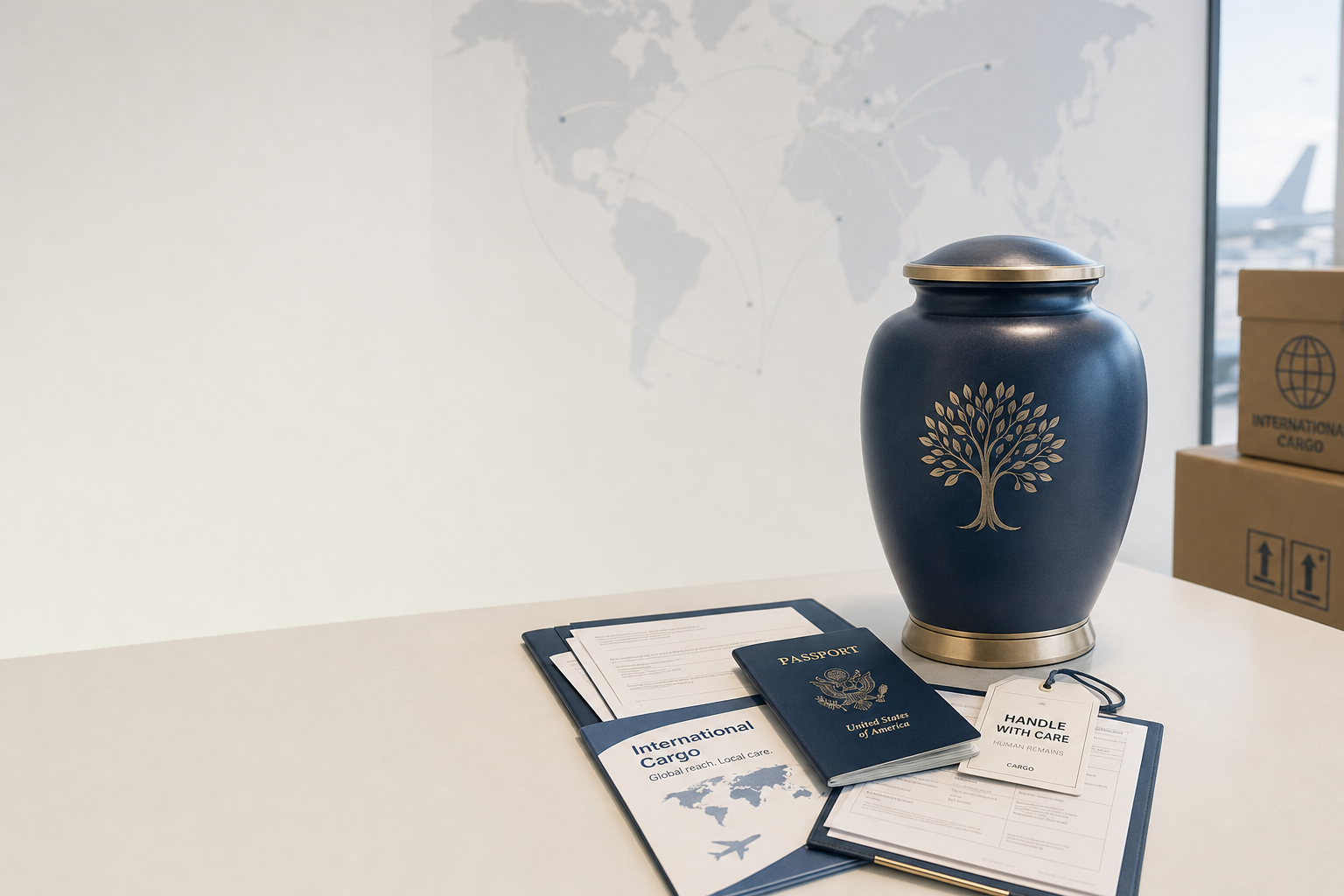
There is no single worldwide document list for transporting cremated remains. Requirements depend on the countries involved and the reason for travel. Commonly requested documents may include:
- Certified copy of the death certificate.
- Cremation certificate or statement from the crematory.
- Certificate of disposition, where applicable.
- Identification or passport information for the deceased.
- Authorization from the receiving funeral home or cemetery.
- Import, transit, or health permits required by the destination country.
- Certified translations when documents are not written in an accepted language.
The U.S. Department of State explains that requirements for transporting remains vary by country and recommends contacting the relevant U.S. embassy or consulate for country-specific guidance. The same principle applies when traveling from another country: families should consult the destination country’s embassy, consulate, customs authority, or health department. ([travel.state.gov](https://travel.state.gov/en/international-travel/living-abroad/death.html?utm_source=openai))
Checking Airline and Transit-Country Rules
Airlines may treat cremated remains as carry-on baggage, checked baggage, or special cargo, depending on their internal rules. Some require the passenger to notify the airline in advance. Others may ask for documents at check-in or impose limitations on connecting flights.
When contacting the airline, ask specific questions:
- Are cremated remains permitted in carry-on baggage?
- Are they permitted in checked baggage?
- Is advance approval or notification required?
- Does the airline require a particular type of urn or packaging?
- Are there restrictions on connecting flights or codeshare carriers?
- Should the remains be transported as cargo instead of passenger baggage?
International air transport also involves the rules of departure, transit, and arrival countries. IATA guidance emphasizes that national laws, airline requirements, documentation, packaging, and handling procedures must all be considered before transport. ([www-ade.iata.org](https://www-ade.iata.org/en/publications/manuals/compassionate-transportation-manual/?utm_source=openai))
Carry-On Travel Versus Shipping
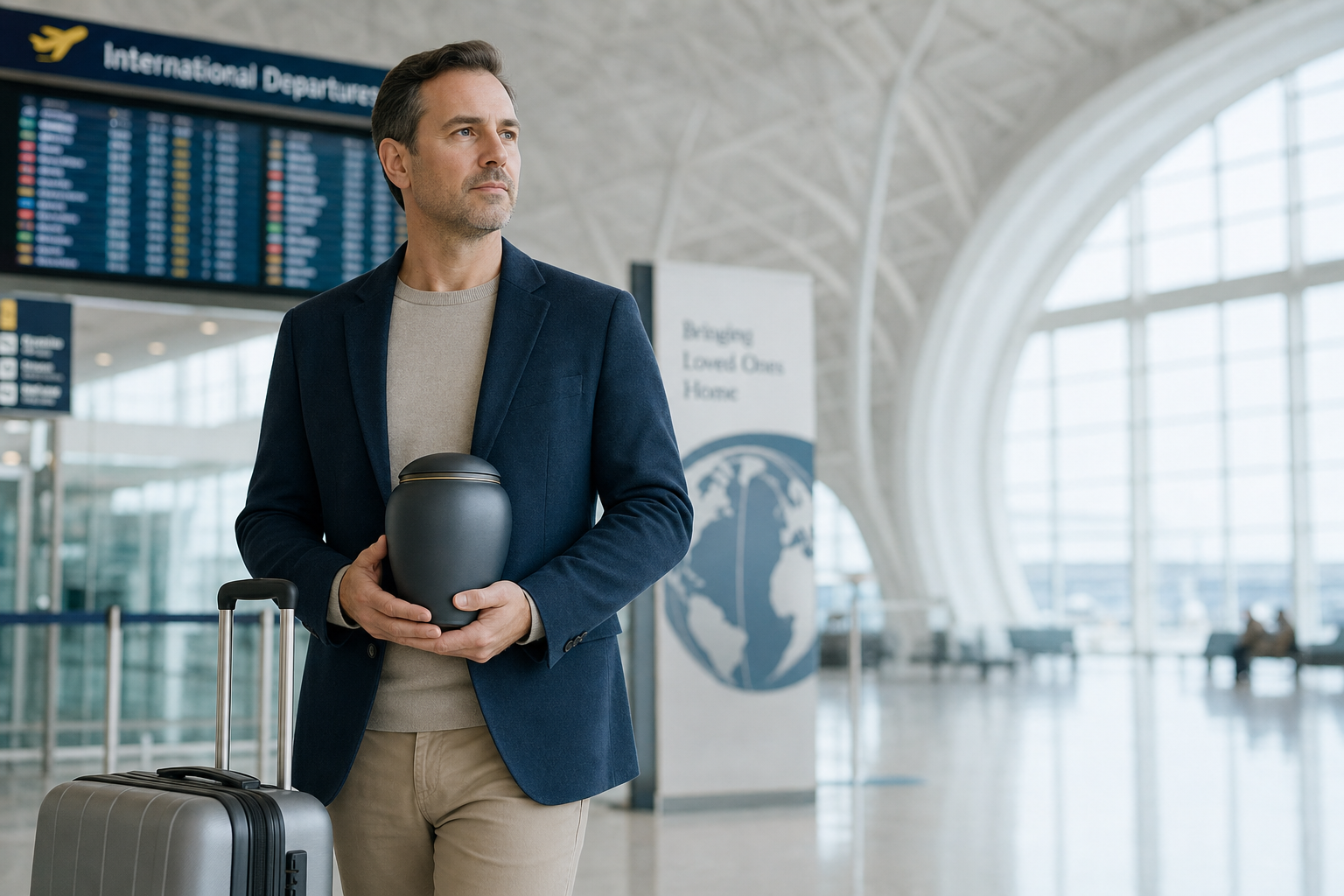
Carrying cremated remains personally may provide reassurance because a family member can keep the container nearby throughout the journey. It may also make sense when the airline permits the remains and the required documentation is ready.
Shipping can be an alternative when family members cannot travel or when the destination’s procedures require professional cargo handling. In the United States, USPS permits international mailing of cremated remains through Priority Mail Express International when the destination country permits the contents and service is available. USPS requires a sealed, sift-proof funeral urn as the international primary receptacle and the use of USPS cremated-remains packaging. ([pe.usps.com](https://pe.usps.com/text/pub52/pub52apxc_036.htm?utm_source=openai))
USPS also requires the contents to be identified on the applicable customs declaration and places responsibility on the sender to obtain documentation and permissions required by the origin and destination countries. ([pe.usps.com](https://pe.usps.com/text/pub52/pub52apxc_036.htm?utm_source=openai))
Courier services and freight arrangements may have different rules. Families should not assume that a standard parcel carrier will accept cremated remains simply because the package is properly sealed.
A Practical Preparation Checklist
Starting early can make the process more manageable. A useful checklist includes:
- Confirm the destination country’s import and customs requirements.
- Check every airline operating the itinerary, including codeshare carriers.
- Ask whether transit countries require additional documents.
- Obtain certified copies and translations if necessary.
- Select an urn that can be screened and safely transported.
- Keep the cremation certificate and death certificate with the traveler.
- Arrive early for check-in and security screening.
- Carry printed confirmation of airline approval when available.
- Plan for the possibility of additional inspection or questions.
Frequently Asked Questions
Can cremated remains go through airport security?
In the United States, TSA permits cremated remains in carry-on and checked baggage, subject to screening. A container that cannot be clearly viewed by X-ray may be refused at the checkpoint, so travelers should confirm the container material before departure. ([tsa.gov](https://www.tsa.gov/travel/security-screening/whatcanibring/all-list?pubDate=20250608&utm_source=openai))
Should cremated remains be placed in carry-on or checked baggage?
Carry-on transport may reduce the risk of baggage separation, but the best option depends on airline policy, container size, and the itinerary. Some airlines do not permit cremated remains in checked baggage.
Do I need a cremation certificate?
Many authorities, airlines, funeral homes, and customs officials may request a cremation certificate. Exact requirements vary, so families should confirm the document list with the airline and destination authorities.
Can cremated remains be mailed internationally?
USPS allows international mailing only when the destination country permits cremated remains and Priority Mail Express International is available. Packaging and customs requirements must be followed precisely. ([pe.usps.com](https://pe.usps.com/text/pub52/pub52apxc_036.htm?utm_source=openai))
Conclusion
Traveling internationally with cremated remains is possible in many circumstances, but it should never be treated like ordinary baggage. The urn, airline, airport security process, customs rules, transit countries, and destination authorities all play a role.
Families can prepare more confidently by verifying requirements early, choosing a suitable container, organizing essential documents, and confirming policies directly with the airline and relevant government authorities. When the arrangements feel overwhelming, an experienced international repatriation professional can help coordinate the details with care and respect.