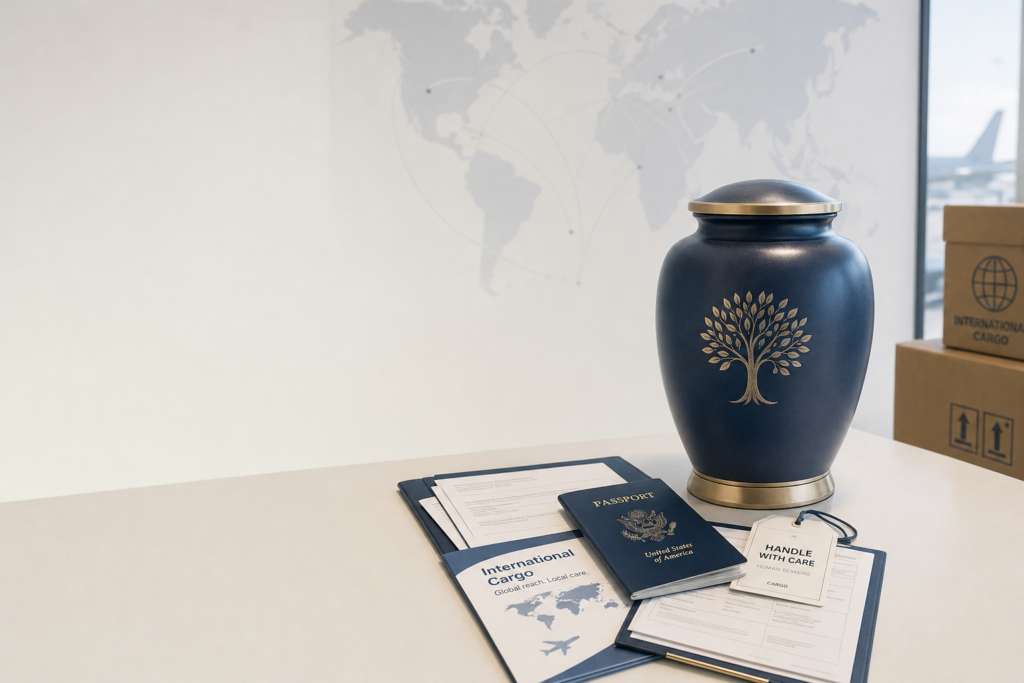
International Transportation of Cremated Remains: Documents, Airline Rules, and Shipping Options
When a loved one is cremated in another country, families may wish to bring the cremated remains home for a memorial service, burial, placement in a cemetery, or a private ceremony. Although ashes are generally simpler to transport than non-cremated remains, international transportation still involves important legal, airline, customs, and packaging requirements.
There is no single worldwide procedure for transporting cremated remains. Requirements can differ based on the country where cremation occurred, the destination country, the airline or carrier, and whether the urn travels with a passenger, as air cargo, or through an approved postal service. Planning early and confirming the requirements with the relevant authorities can help prevent delays and unnecessary distress.
Why international transportation of cremated remains requires planning
Cremated remains are not treated exactly like ordinary personal luggage or a standard parcel. Government authorities and transportation companies may need documentation confirming the identity of the deceased, the fact of cremation, and the lawful movement of the urn across a border.
In the United States, the Department of State explains that disposition of remains must follow both U.S. law and the law of the country where the death occurred. Embassies and consulates may provide information about local procedures and help families identify appropriate funeral homes or authorities, but they generally do not pay transportation costs or make all arrangements on a family’s behalf. ([travel.state.gov](https://travel.state.gov/content/travel/en/international-travel/while-abroad/death-abroad1.htmlwhile-abroad.html?utm_source=openai))
The destination country may also have its own rules for importing ashes. Some authorities may require prior approval, a translated death certificate, a cremation certificate, an import permit, or a specific type of urn. Others may have simpler procedures. Because these requirements vary, families should verify them before booking travel or dispatching a shipment.
Common documents that may be requested
The exact document package depends on the route and the authorities involved. A funeral director or repatriation provider can help determine which documents apply. Families are commonly asked to prepare some combination of the following:
- Certified death certificate
- Cremation certificate or certificate of cremation
- Certificate of disposition or local authorization, where applicable
- Copy of the deceased person’s passport or government identification
- Transit permit, export authorization, or import authorization, if required
- Consular documentation for certain international movements
- Professional translations and document authentication, when required by the destination country
These documents should be checked for consistency. The name, date of birth, date of death, and other identifying information should match across the records. If a document is not in the language accepted by the destination authority, a certified translation may be necessary.
Families should also ask whether original documents, certified copies, or scanned copies are required. Keeping a complete digital file and a separate paper file can be useful, but original certificates should not be surrendered without confirming how and when they will be returned.
Choosing an urn for international travel
Urn selection can affect whether cremated remains can pass through airport screening or be accepted by a carrier. For passenger travel from the United States, the Transportation Security Administration states that cremated remains are permitted in both carry-on and checked baggage, but some airlines do not allow them in checked luggage. TSA also advises using a container made from a material that can be clearly screened by X-ray, such as wood or plastic. If the container creates an opaque image, it may not be allowed through the security checkpoint. ([tsa.gov](https://www.tsa.gov/travel/security-screening/whatcanibring/all-list?pubDate=20250608&utm_source=openai))
TSA officers will not open a container containing cremated remains, even if a traveler requests that they do so. This makes a screening-friendly container especially important. A temporary travel urn may be used for transportation, with the remains later transferred to a permanent memorial urn.
Before traveling, families should confirm:
- Whether the airline accepts cremated remains in carry-on baggage
- Whether advance notice or special documentation is required
- Whether the urn must be sealed or placed inside additional protective packaging
- Whether the airline has size, weight, or routing restrictions
- What procedures apply during connecting flights and international transfers
Traveling with cremated remains by air
When a family member accompanies the urn, the airline’s policy is just as important as airport security rules. Airlines may classify cremated remains as carry-on baggage, special baggage, or cargo, and their procedures can differ even when the same route is involved.
Contact the airline before purchasing a ticket and ask for its current written policy. The traveler should explain that the container holds human cremated remains and ask what documents must be available at check-in, security, transit points, and arrival.
For unaccompanied transportation, funeral homes and specialized repatriation providers may coordinate air cargo services. The International Air Transport Association maintains industry guidance covering airline acceptance, documentation, packing, handling, marking, and labeling for the transport of human remains. ([iata.org](https://www.iata.org/en/publications/manuals/compassionate-transportation-manual?utm_source=openai))
Using a professional provider may be helpful when the route includes multiple countries, tight connections, language barriers, or destination-specific documentation. It can also reduce the burden on family members during an already difficult period.
Shipping cremated remains internationally through the postal service
For shipments sent from the United States, USPS permits international mailing of cremated remains only when the destination country allows them and Priority Mail Express International service is available for that country. USPS requires a sealed, sift-proof funeral urn inside a strong outer container with adequate cushioning, and the contents must be identified on the applicable customs declaration. ([pe.usps.com](https://pe.usps.com/text/imm/immc1_018.htm?utm_source=openai))
USPS also updated its packaging requirements effective March 1, 2025, requiring mailers to use USPS Cremated Remains shipping supplies for human or animal cremated remains. ([pe.usps.com](https://pe.usps.com/FederalRegisterNotice?forYear=2025&utm_source=openai))
Postal shipping should not be arranged until the destination country’s individual mailing restrictions have been checked. A country may prohibit cremated remains by mail, limit the available service, or require additional documentation at customs.
Customs and arrival procedures
At the destination, the urn may be inspected by customs or another government authority. The traveler or consignee may need to declare the cremated remains and present supporting documents. Even when a country permits entry, customs officials may request proof of cremation or evidence that the shipment is intended for final disposition.
Families should avoid placing unrelated items inside the urn or shipping package. Jewelry, letters, photographs, or other keepsakes may be subject to separate customs rules and should be declared accurately if included.
If cremated remains are being returned to the United States, current CDC guidance states that fully cremated remains do not require a CDC import permit for burial, entombment, or cremation. However, other documents, airline rules, local requirements, or infectious-disease-related circumstances may still affect the movement. ([cdc.gov](https://www.cdc.gov/importation/human-remains/index.html?utm_source=openai))
Practical steps for families
- Confirm the destination country’s rules with its embassy, consulate, customs authority, or funeral authority.
- Request the airline or carrier’s current policy in writing.
- Gather certified documents and arrange translations if needed.
- Choose a secure, sealed, screening-friendly urn.
- Decide whether passenger travel, air cargo, or postal shipping is most suitable.
- Keep copies of every document with the traveler and the receiving funeral home.
- Allow extra time for permits, consular review, customs clearance, and connecting flights.
Frequently Asked Questions
Can cremated remains be taken on an international flight?
Often, yes, but permission depends on the airline, airport security requirements, the departure country, and the destination country. Confirm the rules with the airline before travel and use a container that can be screened.
Do cremated remains need to be in a metal urn?
Not necessarily. For passenger screening in the United States, TSA recommends a container made from a material that allows the contents to be clearly viewed by X-ray. Wood or plastic may be more practical for travel than some metal or stone containers. ([tsa.gov](https://www.tsa.gov/travel/security-screening/whatcanibring/all-list?pubDate=20250608&utm_source=openai))
Is a death certificate always required?
Not always, but many authorities, airlines, carriers, or customs offices may request one. The complete document package depends on the countries involved and the selected transportation method.
Can ashes be mailed internationally?
In some cases. From the United States, USPS allows international mailing only when the destination country permits cremated remains and the required international service is available. Packaging and customs declaration rules must be followed. ([pe.usps.com](https://pe.usps.com/text/imm/immc1_018.htm?utm_source=openai))
Should a family work with a repatriation provider?
Professional assistance can be valuable when documentation, translations, airline coordination, customs, or multiple jurisdictions are involved. A qualified provider can help organize the movement while keeping the family informed about each step.
Conclusion
International transportation of cremated remains is often manageable, but it should never be treated as ordinary luggage or routine shipping. The safest approach is to verify the destination country’s requirements, confirm the carrier’s policy, prepare accurate documents, and use secure packaging that meets the chosen transportation method.
When families are grieving, having a clear plan can provide reassurance. Early coordination with the appropriate authorities, funeral professionals, airline, postal service, or repatriation provider can help ensure that a loved one’s cremated remains reach their destination respectfully and with fewer avoidable delays.