When a family needs to return cremated remains to another country, the process may appear simpler than transporting a body. In practice, international repatriation of cremated remains still requires careful planning. Families may need to coordinate with a crematory, funeral home, airline, postal service, customs authorities, an embassy, or officials in the destination country.
The correct process depends on where the ashes are leaving from, where they are going, how they will travel, and whether a family member will carry them personally. Requirements can also change based on local law and the policies of the airline or shipping provider. Starting early helps prevent avoidable delays during an already emotional time.
What Makes Cremated Remains Different?
Cremated remains are generally easier to transport than non-cremated remains because they do not require the same type of casket, preservation, or mortuary handling. However, they remain human remains and may be regulated as a sensitive shipment or travel item.
International transportation involves two separate sets of requirements: the rules of the country where the ashes originate and the rules of the destination country. Transit countries and individual airlines may also impose additional conditions. There is no single worldwide procedure that applies to every route. IATA notes that documentation, packaging, labeling, and country requirements must be checked for each shipment or itinerary. ([iata.org](https://www.iata.org/en/publications/newsletters/iata-knowledge-hub/what-you-need-to-know-about-the-transportation-of-human-remains-by-air/?utm_source=openai))
Two Common Transportation Options
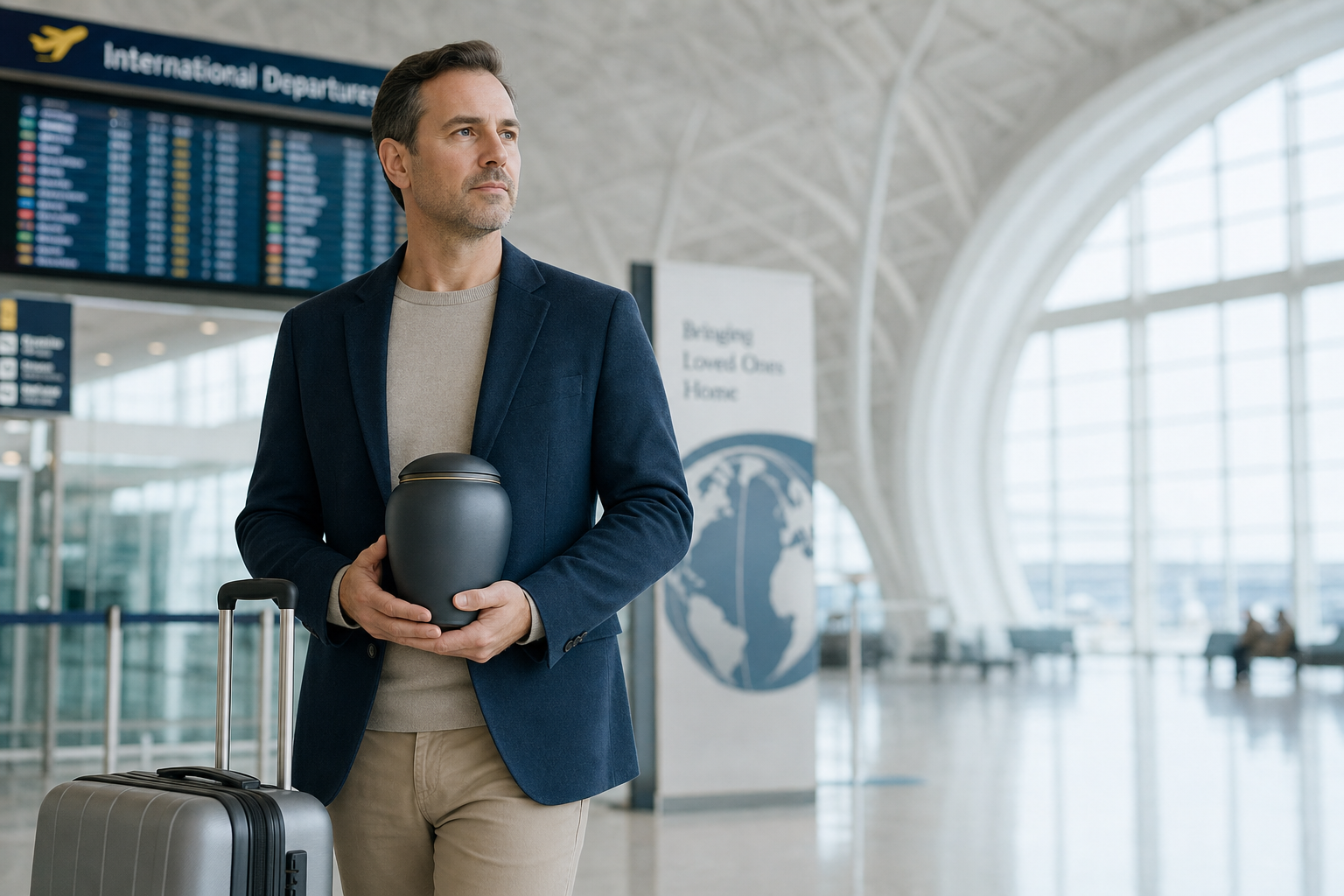
Carrying the urn during air travel
Some families choose to travel with the cremated remains in their carry-on luggage. This can provide a greater sense of control and may allow the family to accompany the ashes directly to their final destination.
Before booking, the traveler should contact every airline on the itinerary. TSA allows cremated remains in carry-on and checked baggage, but advises travelers to verify airline restrictions. TSA also recommends a temporary or permanent container made from a material that can be clearly viewed by X-ray equipment, such as wood or plastic. Containers made from materials that produce an opaque image may not be accepted at the security checkpoint, and TSA officers will not open the container for inspection. ([tsa.gov](https://www.tsa.gov/travel/security-screening/whatcanibring/all-list?pubDate=20250608&utm_source=openai))
A traveler should consider using a temporary transport container and transferring the remains into a permanent urn after arrival. This may be especially helpful when the permanent urn is made from metal, stone, ceramic, or another material that could make screening difficult.
Shipping the ashes internationally
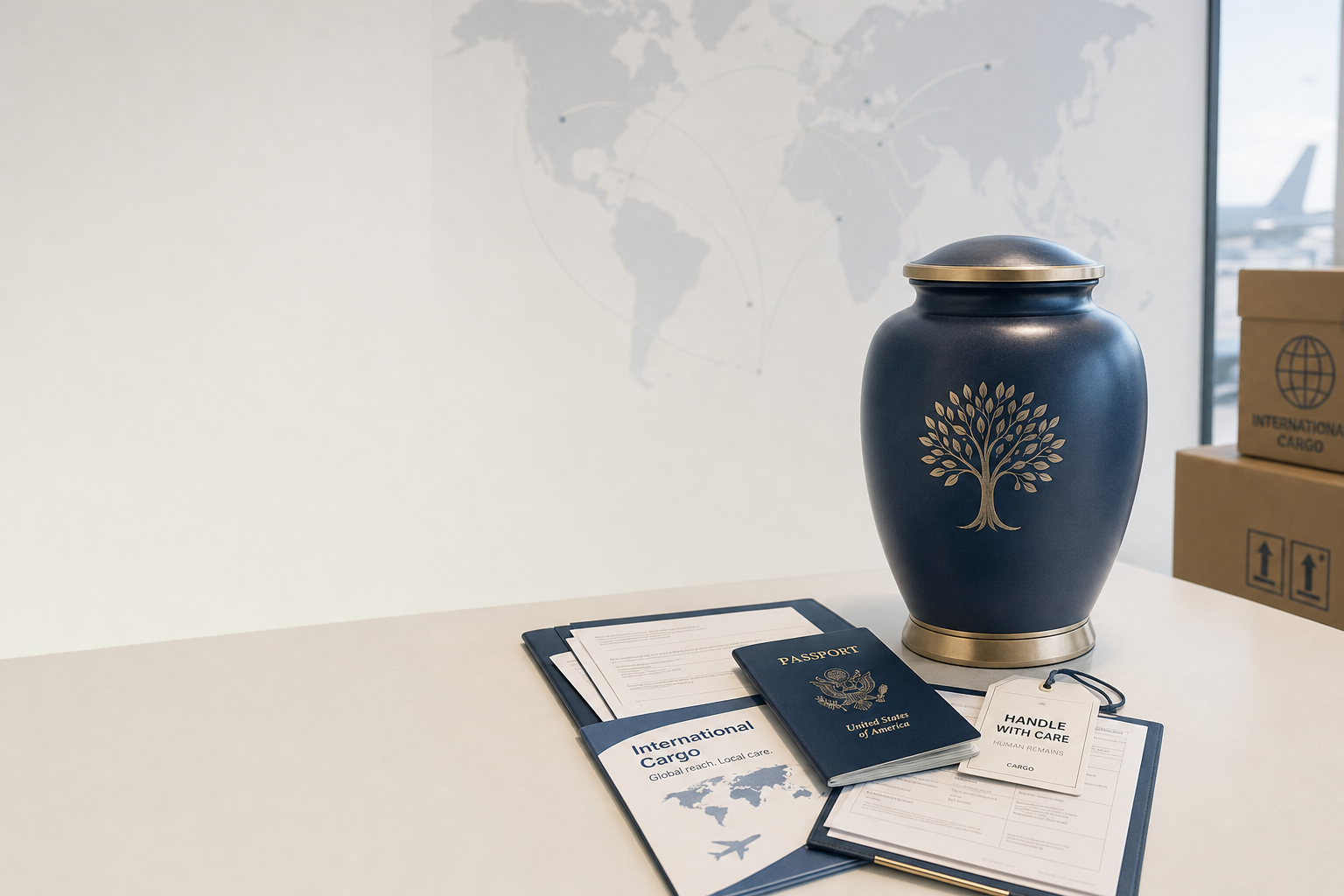
Another option is to send the cremated remains through an approved postal or specialized transportation service. In the United States, USPS states that international cremated-remains shipments must use Priority Mail Express International when that service is available and when the destination country permits the contents. USPS also requires the use of its cremated-remains packaging and an appropriate customs declaration. ([usps.com](https://www.usps.com/international/shipping-restrictions.htm?utm_source=openai))
Families should not assume that a standard courier will accept an urn. USPS identifies itself as the only major U.S. shipping company that ships cremated remains, while private providers may have their own restrictions or may only offer transportation through funeral-industry arrangements. Always confirm acceptance before preparing the package.
Documents Families May Need
Documentation varies by destination, but the following records are commonly requested or useful:
- Certified death certificate
- Cremation certificate or cremation permit
- Certificate of disposition, when issued by the local authority
- Proof of relationship or authorization from the next of kin, when required
- Passport or identification documents for the traveler
- Customs declaration for an international postal shipment
- Official translation if a document is not written in an accepted language
- Import, export, transit, or embassy documentation required by the countries involved
These documents are not automatically required on every route. For example, U.S. Customs and Border Protection states that death and cremation records may be required when ashes enter the United States, and that additional export or embassy paperwork may be necessary for international shipments. Documents in another language may need an English translation for U.S. entry. ([help.cbp.gov](https://www.help.cbp.gov/s/article/Article-1404?language=en_US&utm_source=openai))
If a U.S. citizen dies abroad, the Department of State explains that consular officers can provide information about local arrangements and shipment of remains. The embassy or consulate may also help identify local funeral homes, attorneys, or authorities, although the family or estate remains responsible for transportation costs. ([travel.state.gov](https://travel.state.gov/en/international-travel/living-abroad/death.html?utm_source=openai))
Preparing the Urn and Package
Safe packaging protects the ashes, reduces the risk of damage, and helps authorities identify the contents. USPS requires an international shipment to use a sealed, sift-proof funeral urn as the primary container. The urn must be placed inside a sturdy outer package with sufficient cushioning to prevent movement or breakage. ([pe.usps.com](https://pe.usps.com/PUB52_Archive/NHTML/PUB52_Archive_20220705/pub52apxc_036.htm?utm_source=openai))
For personal air travel, the container should be secure, clearly labeled when appropriate, and suitable for X-ray screening. A sealed inner container placed inside a temporary travel container can provide an additional layer of protection. The family should keep original documents in hand luggage rather than placing them inside checked baggage or the shipping package.
Common Problems That Cause Delays
Many transportation problems arise because the family receives general advice but does not confirm the specific route. Common issues include:
- Using an urn that cannot pass through airport screening
- Assuming all airlines have identical policies
- Sending ashes to a country that prohibits or restricts postal delivery
- Leaving the cremation certificate or death certificate at home
- Failing to translate or authenticate documents
- Listing the package inaccurately on a customs form
- Booking travel before confirming the airline’s acceptance procedures
- Using a shipping service that does not handle human cremated remains
Because rules can differ even between airlines serving the same destination, written confirmation is valuable. Families should ask what documents are required, whether the urn may be carried in the cabin, whether advance notification is necessary, and where the traveler should report at the airport.
A Practical Planning Checklist
Before arranging international transportation, families can work through the following steps:
- Confirm the destination country’s import rules with its embassy, consulate, customs authority, or local funeral professional.
- Ask the departure and destination airlines about carry-on, checked-baggage, cargo, and documentation policies.
- Obtain several certified copies of the death certificate and cremation documentation.
- Arrange certified translations or authentication if required.
- Select an urn and transport container suitable for the chosen method.
- Complete customs paperwork accurately and identify the contents honestly.
- Keep tracking information, contact details, and copies of all records together.
- Allow additional time for weekends, holidays, customs review, and connecting flights.
Frequently Asked Questions
Can I take cremated remains on an international flight?
Often, yes, but acceptance depends on the airline, airport security procedures, container material, and destination-country rules. Contact the airline before departure and use a container that can be screened by X-ray. ([tsa.gov](https://www.tsa.gov/travel/security-screening/whatcanibring/all-list?pubDate=20250608&utm_source=openai))
Can cremated remains be mailed internationally from the United States?
USPS permits international mailing when the destination country allows cremated remains and Priority Mail Express International is available. USPS packaging and customs requirements must be followed. ([usps.com](https://www.usps.com/international/shipping-restrictions.htm?utm_source=openai))
Do ashes always need a death certificate?
Not always. Requirements depend on the countries, carriers, and method of transportation involved. Even when a document is not formally required, carrying the death certificate and cremation certificate can help resolve questions at an airport or border.
Should I use the permanent urn for air travel?
Not necessarily. A temporary container made from a lightweight, X-ray-friendly material may make airport screening easier. The permanent urn can be used after arrival if it is not suitable for inspection.
Conclusion
International repatriation of cremated remains can be arranged safely and respectfully when the family confirms the requirements before travel or shipment. The most important steps are choosing the right transportation method, checking airline and destination-country rules, preparing accurate documents, and using secure packaging.
Because international regulations and carrier policies vary, families should verify the current requirements with the relevant authorities and transportation providers. When the process feels overwhelming, an experienced repatriation coordinator can help organize the moving parts while keeping the family informed at each stage.