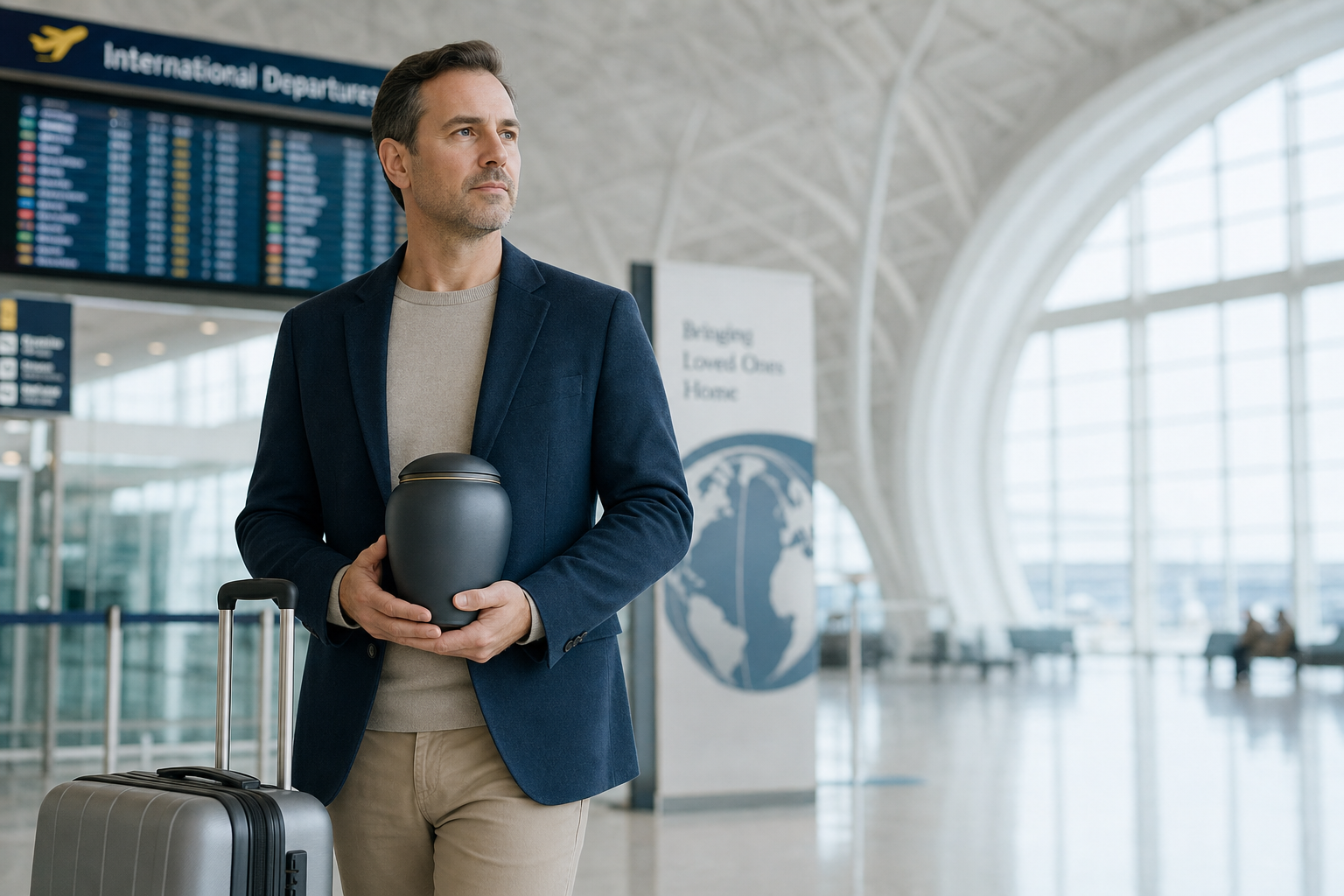
Returning a loved one’s cremated remains to another country can provide families with comfort and make it possible to hold a funeral, memorial service, or final ceremony close to home. However, international travel with ashes still requires careful preparation. Documents, airport screening procedures, airline policies, customs requirements, and destination-country rules may all affect the journey.
The process is often more straightforward than transporting a body, but it should never be treated as an informal travel arrangement. Requirements can differ significantly depending on the country where the cremation took place, the destination, the route, and the airline. Families should confirm the current rules with the relevant authorities, airline, funeral director, and consulate before making travel plans.
What Does International Travel With Cremated Remains Involve?
International travel with cremated remains generally means transporting an urn or approved container across a national border, either as checked baggage, carry-on baggage, or through a professional cargo or funeral-service arrangement. Some families travel with the urn themselves, while others arrange shipment through a funeral home or specialist provider.
The correct option depends on the airline, airport, destination country, and the family’s circumstances. IATA explains that there is no single universal international standard for every country’s documentation and handling requirements, which is why advance verification is important. ([iata.org](https://www.iata.org/en/publications/manuals/compassionate-transportation-manual/?utm_source=openai))
Documents Families May Need
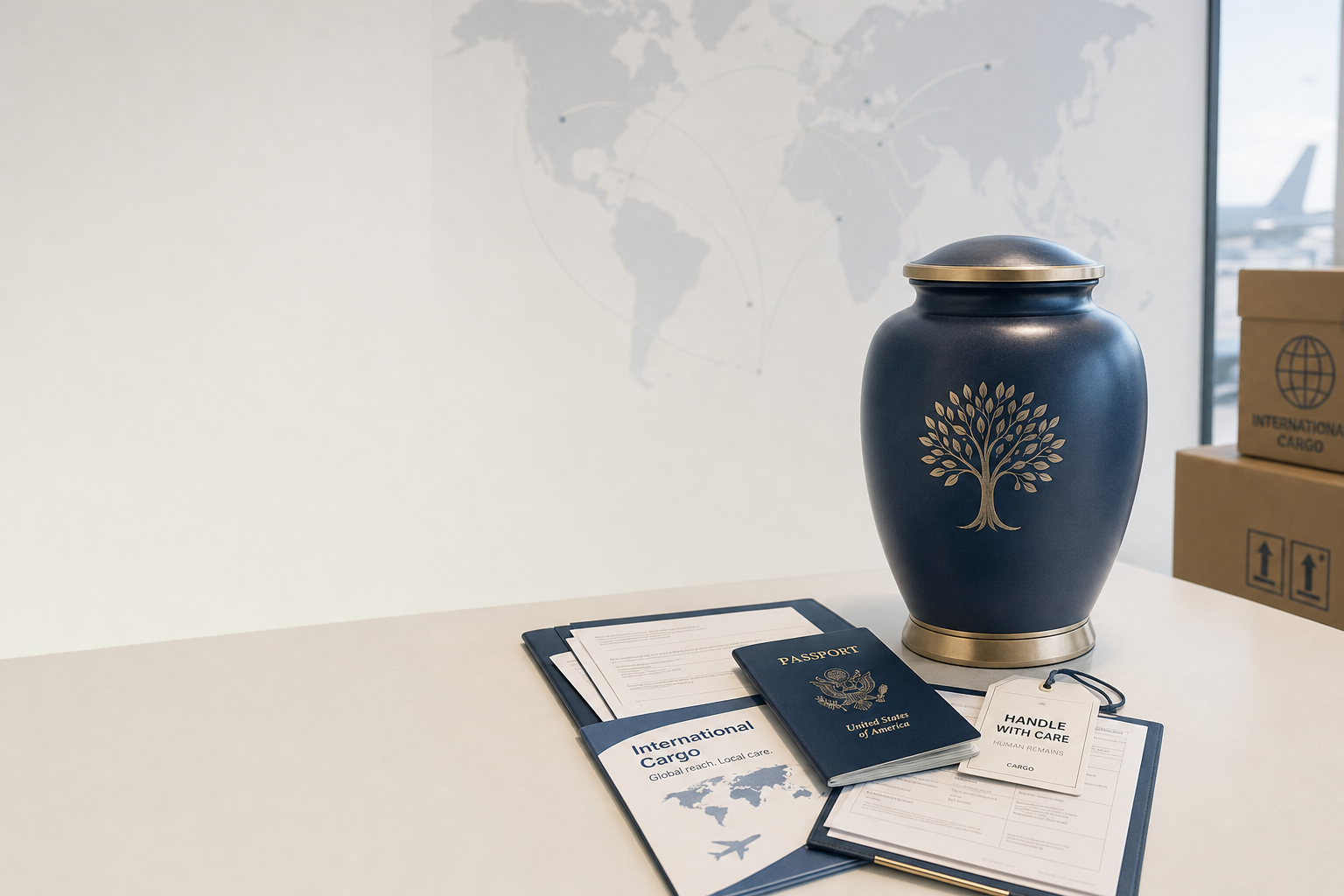
Although requirements vary, families are commonly asked to carry documents proving the identity of the deceased, the fact of death, and the completion of cremation. Depending on the route, documents may need to be originals, certified copies, translations, notarizations, or legalizations.
Potential documents include:
- Certified death certificate
- Certificate of cremation
- Funeral home or crematory documentation
- Passport or identification documents relating to the deceased, where applicable
- Transit, export, import, or health permits required by the countries involved
- Official translations if documents are not accepted in the destination country’s language
- Authorization from the next of kin or legal representative, when requested
For example, UK government guidance states that travelers leaving a country with human ashes will normally need to show the death certificate and certificate of cremation, while also emphasizing that each country may impose additional requirements. ([gov.uk](https://www.gov.uk/after-a-death/death-abroad?utm_source=openai))
Families should also check whether the destination country requires documents to be authenticated or accompanied by a consular letter. A document that is sufficient for airline screening may not be sufficient for customs or local funeral authorities.
Choosing the Right Urn or Container
The urn is both a respectful vessel and an important part of the travel process. Security screening equipment must be able to identify what is inside the container without requiring officers to open it.
The Transportation Security Administration advises travelers in the United States to use a temporary or permanent container made from a material such as wood or plastic. Containers made from materials that create an opaque image during screening may not be accepted because screening officers cannot clearly determine the contents. TSA also states that officers will not open a cremation container, even at a passenger’s request. ([tsa.gov](https://www.tsa.gov/travel/security-screening/whatcanibring/all-list?pubDate=20250608&utm_source=openai))
Before traveling, consider:
- Using a non-metallic or screening-friendly container
- Keeping the original crematory seal intact
- Placing the urn in protective packaging to prevent movement or damage
- Carrying documents separately in a waterproof folder
- Asking the funeral home whether a temporary travel container is appropriate
Some families use a temporary container for the journey and transfer the ashes into a permanent urn after arriving at the destination. This can be practical when the permanent urn is made from metal, stone, or another material that may complicate screening.
Carry-On, Checked Baggage, or Professional Transport?
Airline policies are not identical. Some airlines allow cremated remains in carry-on baggage, while others may restrict or prohibit them in checked baggage. TSA notes that certain airlines do not permit cremated remains in checked bags and recommends contacting the airline before travel. ([tsa.gov](https://www.tsa.gov/travel/security-screening/whatcanibring/all-list?pubDate=20250608&utm_source=openai))
Carrying the urn in hand luggage may allow the traveler to maintain personal control of the remains, but the container still must pass security screening. Checked baggage may create additional risks, including delays, mishandling, or separation from the traveler. For these reasons, many families prefer to discuss the arrangement directly with the airline and a funeral professional before booking.
Professional transport may be more suitable when:
- The traveler cannot accompany the remains
- The itinerary includes multiple countries or connecting flights
- The destination has complex import procedures
- The family requires document coordination
- The urn must be transported as specialized funeral cargo
IATA guidance confirms that cremated remains may be transported by passengers or shipped as cargo, but packaging, documentation, and individual airline procedures must be checked for the specific journey. ([iata.org](https://www.iata.org/en/publications/newsletters/iata-knowledge-hub/what-you-need-to-know-about-the-transportation-of-human-remains-by-air/?utm_source=openai))
Customs and Destination-Country Requirements
Passing airport security does not automatically guarantee entry into another country. Customs authorities may ask to inspect documents, verify the contents, or confirm that the ashes are being imported for a lawful purpose.
Requirements can differ based on whether the ashes are being:
- Carried by a family member
- Shipped through a funeral home
- Interred in a cemetery
- Scattered in a specific location
- Stored temporarily before a memorial service
Some countries may require advance approval, an import permit, consular involvement, or specific packaging. Others may have fewer formal requirements but still expect the traveler to present a death certificate and cremation certificate. Families should consult the embassy or consulate of the destination country, the local customs authority, and the airline before departure.
A Practical Preparation Checklist
Preparing early can reduce avoidable stress. A useful checklist includes:
- Confirm the destination country’s rules with its embassy or consulate.
- Ask the airline whether ashes may be carried in the cabin or checked baggage.
- Verify the required container material and size.
- Obtain certified copies of the death and cremation certificates.
- Arrange official translations or authentication if required.
- Confirm whether customs forms, permits, or advance notices are needed.
- Keep all documents accessible throughout the journey.
- Allow extra time at the airport for screening and border procedures.
Do not place the urn in ordinary luggage without first confirming the airline’s policy. Also avoid opening or transferring the cremated remains during travel unless a qualified funeral professional has advised that it is safe and lawful.
Frequently Asked Questions
Can I take cremated remains on an international flight?
Often, yes, but permission depends on the airline, departure airport, destination country, and container. Contact the airline before booking and ask for its current policy in writing if possible.
Do cremated remains need to be in a special urn?
The container must be secure and suitable for screening. In the United States, TSA recommends a lightweight container such as wood or plastic because some materials may block the screening image. ([tsa.gov](https://www.tsa.gov/travel/security-screening/whatcanibring/all-list?pubDate=20250608&utm_source=openai))
What documents should I carry?
A certified death certificate and certificate of cremation are commonly requested. Additional permits, translations, authentication, or customs documents may be required depending on the countries involved.
Should I tell the airline in advance?
Yes. Even when an airline permits cremated remains, it may have specific rules about cabin baggage, checked baggage, container materials, advance notification, or connecting flights.
Can a funeral home transport the ashes instead?
In many cases, a funeral home or specialist provider can coordinate shipment as cargo. This may be helpful when the family cannot travel or when the route involves complex documentation. The provider should confirm the requirements for the exact origin and destination.
Conclusion
Traveling internationally with cremated remains requires sensitivity, preparation, and careful attention to changing rules. The most important steps are to confirm airline requirements, use a screening-friendly container, organize certified documents, and verify the destination country’s customs and import procedures.
Because regulations differ by country and airline, families should avoid relying on general assumptions or outdated advice. A funeral professional, international repatriation specialist, airline representative, embassy, or consulate can help clarify the requirements for a particular journey and provide reassurance during a difficult time.