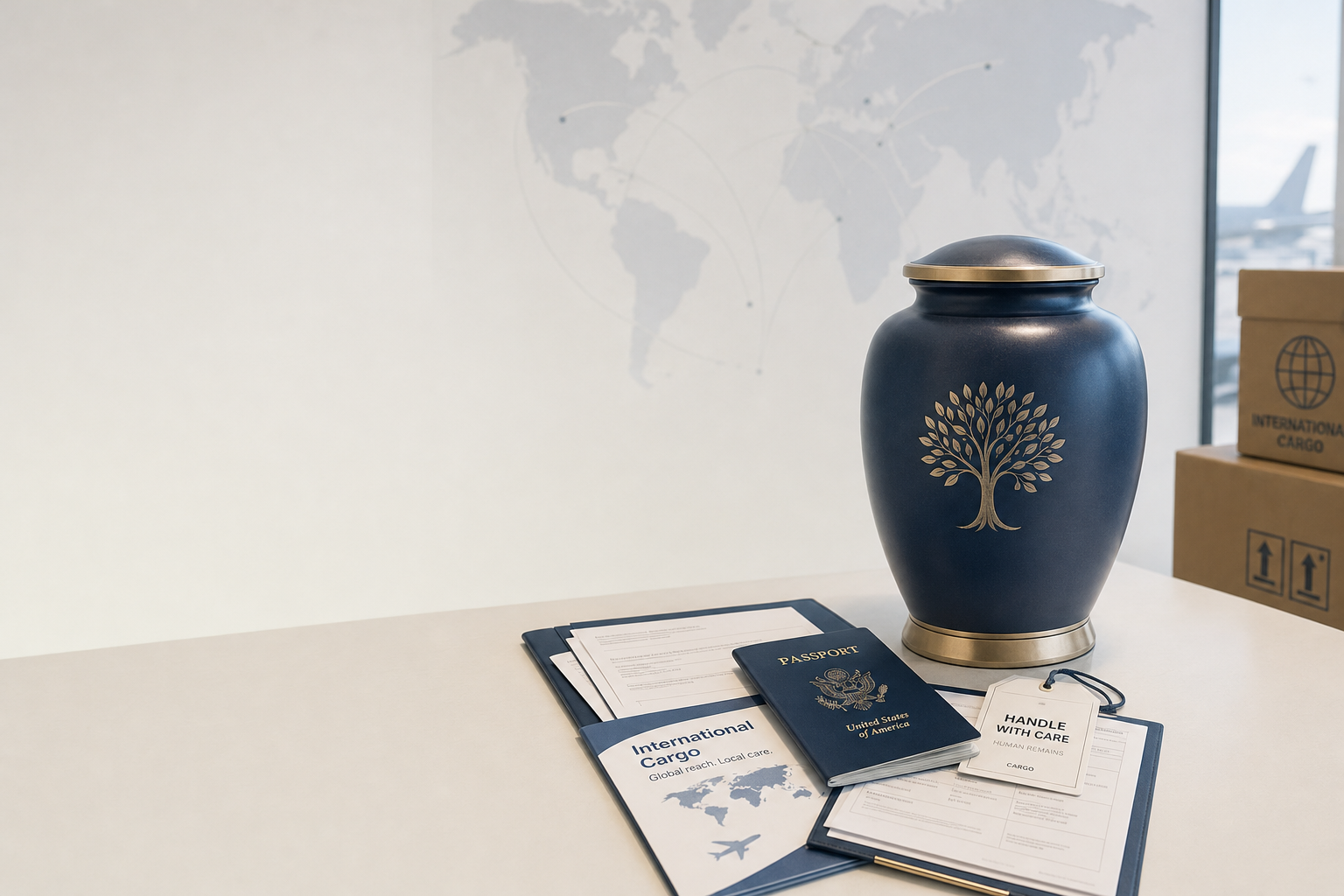
When a loved one is cremated in another country, bringing the ashes home can feel more manageable than transporting a full set of human remains. However, international transportation of cremated remains still requires careful planning. Families may need to coordinate with a crematory, funeral director, airline, airport security officials, customs authorities, and agencies in both the departure and destination countries.
The process is not identical everywhere. Each country may have its own rules for cremation certificates, export permits, translations, customs clearance, and the type of urn permitted for travel. Airline policies can also differ, even when government authorities allow the shipment or carriage of ashes. Understanding the major considerations can help families avoid delays and make arrangements with greater confidence.
What Does International Transport of Cremated Remains Involve?
International transport of cremated remains generally means moving ashes from the country where cremation occurred to another country for burial, placement in a columbarium, scattering, or safekeeping by the family. Depending on the route, the remains may travel as accompanied baggage, unaccompanied air cargo, or through a specialized funeral services provider.
The correct method depends on several factors, including the destination country, the airline, the type of urn, the available documentation, and whether the family member is traveling with the remains. A professional repatriation provider or funeral director can help determine which option is most practical for the route involved.
Documents Families May Need
Documentation is one of the most important parts of transporting cremated remains internationally. Requirements vary by country, so families should confirm the exact list with the destination country’s embassy or consulate, the local authorities where the cremation occurred, and the airline.
Commonly requested documents may include:
- Certified copy of the death certificate
- Cremation certificate or certificate of cremation
- Certificate identifying the contents of the urn
- Export permit or authorization from the country of departure
- Import permit or approval from the destination country, where required
- Consular documents or mortuary certificates
- Certified translations into the required language
- Funeral home or crematory statement confirming the ashes are contained in the urn
Not every shipment will require every document listed above. Some countries request apostilles, authentication, notarization, or specific forms issued by local authorities. Families should avoid relying on a document checklist from a different country or a previous shipment because rules can change and are not interchangeable.
Choosing the Right Urn for Air Travel
The urn is both a meaningful memorial object and a practical transportation container. For air travel, a container that can be screened clearly is often the easiest option. The Transportation Security Administration states that cremated remains may be permitted in carry-on or checked baggage, but airlines may impose their own restrictions. TSA also recommends a temporary or permanent container made from a lightweight material such as wood or plastic because opaque materials may prevent security officers from seeing the contents during screening. ([tsa.gov](https://www.tsa.gov/travel/security-screening/whatcanibring/all-list?pubDate=20250608&utm_source=openai))
A metal, stone, ceramic, or heavily sealed urn may create difficulties if airport screening equipment cannot produce a clear image. Security officers generally will not open an urn, even at a passenger’s request. If the container cannot be screened, it may not be allowed through the checkpoint. Families should therefore ask the airline and airport security authority about acceptable containers before traveling.
When ashes are shipped as cargo, packaging requirements may differ from those for passenger baggage. A funeral director or specialist transportation provider can help select outer packaging that protects the urn while keeping the documentation accessible to authorized handlers.
Traveling With Cremated Remains as Carry-On Baggage
Some families prefer to personally accompany the urn. This may provide emotional comfort and reduce concerns about the remains traveling separately. Before choosing this option, contact every airline involved in the itinerary, including codeshare or connecting carriers.
Ask the airline:
- Whether cremated remains are accepted in carry-on baggage
- Whether advance notification or approval is required
- What documents must be presented at check-in or boarding
- Whether the urn must be placed in a particular type of container
- Whether connecting airports or partner airlines have additional rules
Keep the urn and documents in your carry-on baggage rather than placing them in checked luggage unless the airline specifically confirms otherwise. Carry the original documents, along with several copies, in a protective folder. It is also wise to arrive early because screening or check-in may take longer than a normal journey.
Shipping Cremated Remains as Air Cargo
When a family cannot travel with the ashes, air cargo may be an appropriate alternative. The shipment is typically arranged through a funeral home, crematory, cargo agent, or international repatriation provider. The responsible party coordinates collection, documentation, packaging, airline booking, customs procedures, and delivery to the receiving funeral home or family representative.
Air cargo can be particularly useful when:
- The destination country requires formal funeral-home-to-funeral-home handling
- The airline does not permit ashes in passenger baggage
- The family is unable to travel immediately
- The urn is not suitable for airport screening
- Several documents or permits must be coordinated before arrival
Airlines and freight handlers may use different procedures for cremated remains. IATA’s Compassionate Transportation Manual provides industry guidance covering documentation, packaging, handling, marking, labeling, and government requirements, but individual carriers and countries may apply additional rules. ([iata.org](https://www.iata.org/en/publications/manuals/compassionate-transportation-manual/?utm_source=openai))
Border, Customs, and Destination-Country Requirements
International transportation involves both export from one country and entry into another. A cremation that was legally completed in the country of departure does not automatically mean the ashes can enter the destination country without further review.
Before arranging travel, verify:
- Whether the destination permits the importation of cremated remains
- Whether an import permit is required
- Which authority issues approval or clearance
- Whether documents need authentication or translation
- Whether customs must be notified in advance
- Where the ashes may be released after arrival
For remains entering the United States, CDC guidance states that fully cremated remains generally do not require a CDC import permit when they are imported for burial, entombment, or cremation. Even so, other federal, state, airline, customs, and foreign-country requirements may apply. ([cdc.gov](https://www.cdc.gov/importation/human-remains/index.html?utm_source=openai))
The U.S. Department of State also explains that burial or cremation must comply with both U.S. and foreign law, and that available arrangements depend on local law and practice. Consular officials may provide information about local procedures and help families identify appropriate offices or funeral providers. ([travel.state.gov](https://travel.state.gov/content/travel/en/international-travel/while-abroad/death-abroad1.htmlwhile-abroad.html?utm_source=openai))
Common Problems That Can Cause Delays
Many delays occur because families receive different instructions from different organizations or begin travel before the paperwork is complete. Common issues include an uncertified death certificate, missing cremation documentation, an urn that cannot pass screening, a translation that does not meet local requirements, or a connecting airline with a stricter policy.
Other complications may arise when:
- The name on the urn documents does not match the passport or death certificate
- The cremation occurred recently and certified records are not yet available
- The route crosses multiple countries with different entry rules
- The receiving cemetery or family member has not been identified
- The airline changes cargo schedules or refuses a particular container
For these reasons, families should confirm requirements in writing wherever possible and build extra time into the itinerary.
A Practical Preparation Checklist
A simple checklist can make the process less overwhelming:
- Confirm the destination country’s requirements with its embassy or consulate.
- Ask the crematory or funeral director for certified documents and copies.
- Contact each airline operating the journey.
- Select an urn and outer container suitable for the chosen transportation method.
- Arrange translations, authentication, or permits if required.
- Prepare a folder containing originals, copies, contact details, and travel confirmations.
- Confirm who will receive the remains after arrival.
- Allow additional time for airport screening, customs, and unexpected document checks.
Frequently Asked Questions
Can I take cremated remains on an international flight?
Possibly. Some airlines allow cremated remains in carry-on baggage, but policies differ. The urn must also meet airport screening requirements, and the destination country may require specific documents or permits.
Can cremated remains go in checked baggage?
Some airlines permit this, while others do not. Because policies vary and checked baggage can be delayed, families should obtain confirmation directly from the airline before departure.
Do cremated remains need to be in a special urn?
There is no single worldwide urn standard. For passenger travel, a lightweight, non-opaque container may make security screening easier. Cargo shipments may require additional protective packaging.
Is a death certificate enough to cross the border?
Usually, a death certificate alone may not be sufficient. A cremation certificate, export or import authorization, translation, authentication, or airline-specific paperwork may also be required.
Should a funeral professional handle the shipment?
Families can sometimes travel with ashes themselves, but professional assistance may be helpful when the journey involves multiple countries, cargo transport, urgent timing, or complex documentation.
Conclusion
Transporting cremated remains internationally is often more straightforward than moving a full set of human remains, but it still requires careful attention to documentation, urn selection, airline rules, and border requirements. The safest approach is to verify the current requirements for the exact route before making travel arrangements.
When families understand the process and prepare early, they can focus more fully on honoring their loved one. If requirements are unclear or several authorities are involved, a qualified funeral director or international repatriation specialist can help coordinate the details respectfully and accurately.