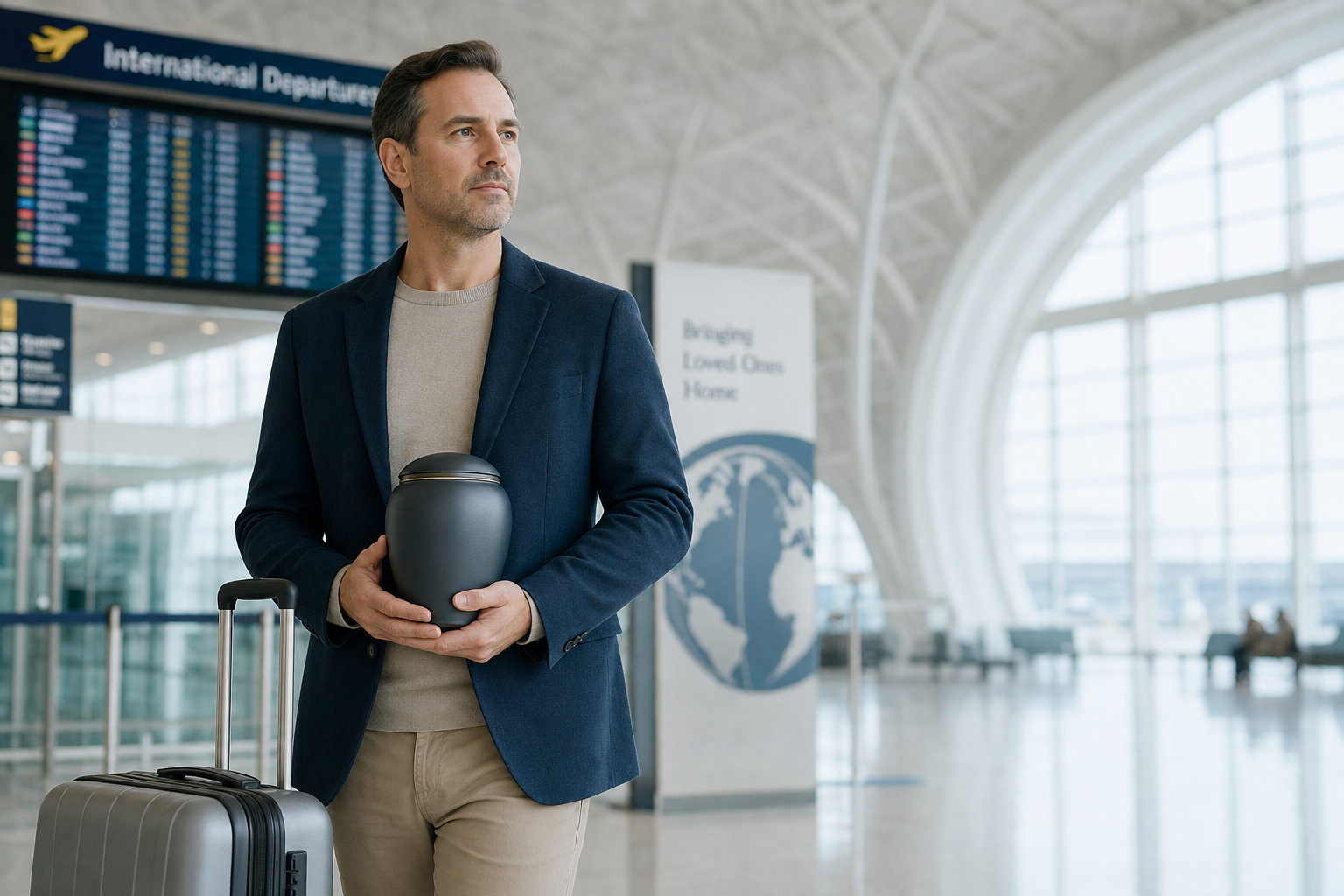
When a loved one is cremated abroad or a family needs to carry ashes across an international border, the journey can feel emotionally difficult and administratively complicated. Although cremated remains are generally easier to transport than a body, they are still subject to airline screening, customs procedures, and the laws of the countries involved.
There is no single worldwide process for traveling with ashes. Requirements may differ depending on the departure country, destination country, airline, transit points, and whether the remains are carried by a passenger or shipped as air cargo. Careful preparation helps reduce delays and gives families greater confidence that their loved one’s remains will be handled respectfully.
Start by Confirming the Route and Method of Transportation
The first decision is whether the cremated remains will travel with a family member or be transported through a funeral home, repatriation specialist, or cargo service. Carrying an urn personally may be appropriate for some routes, while shipping may be more practical when the family cannot travel or when the destination has strict entry procedures.
Before making arrangements, identify:
- The country where the ashes will depart
- The final destination country
- Every country where the passenger or shipment will transit
- The operating airline or airlines
- Whether the remains will travel in a cabin, checked baggage, or cargo
International Air Transport Association guidance emphasizes that documentation, packaging, labeling, and country requirements must be considered together. There is not one universal international standard that replaces each country’s rules or an airline’s individual policy. ([iata.org](https://www.iata.org/en/publications/newsletters/iata-knowledge-hub/what-you-need-to-know-about-the-transportation-of-human-remains-by-air/?utm_source=openai))
Check the Airline’s Policy Before Purchasing a Ticket
Airlines may have different rules for cremated remains. Some permit an urn in carry-on baggage, while others may limit or prohibit cremated remains in checked baggage. Airlines can also impose requirements concerning advance notice, documentation, container dimensions, baggage fees, and the type of service used for cargo transportation.
Families should contact the airline directly and ask for its current policy in writing whenever possible. The important questions include:
- Are cremated remains allowed in carry-on baggage?
- Are they allowed in checked baggage?
- Must the airline be notified before departure?
- Are there restrictions on connecting flights or codeshare partners?
- Does the airline require a death certificate or cremation certificate?
- Are cargo arrangements required for the international portion of the journey?
Do not rely only on a general airport or airline statement. A flight may be operated by one carrier, marketed by another, and transferred to a partner at a connecting airport. Each airline involved should be contacted.
Choose an Urn That Can Be Screened
Security screening is one of the most common practical concerns when an urn is carried through an airport. The Transportation Security Administration advises travelers to use a temporary or permanent crematory container made from a material that allows screening, such as wood or plastic. Some dense materials may prevent security officers from seeing the contents clearly through an X-ray machine. ([tsa.gov](https://www.tsa.gov/travel/security-screening/whatcanibring/all?combine=Light&page=0&utm_source=openai))
A decorative metal, stone, or heavily sealed urn may be meaningful for the final memorial service but less suitable for the journey. Families often use a temporary inspection-friendly container for travel and transfer the ashes into a permanent urn after arrival.
The container should be:
- Securely closed and protected against accidental opening
- Strong enough to withstand normal handling
- Clearly identified according to the carrier’s instructions
- Small enough to meet cabin baggage limits if carried onboard
- Suitable for inspection without requiring the container to be opened
Passengers should tell the security officer that they are carrying cremated remains. Screening officers may make the final decision about whether the container can pass through the checkpoint, even when it appears to meet published guidance.
Prepare the Core Documents
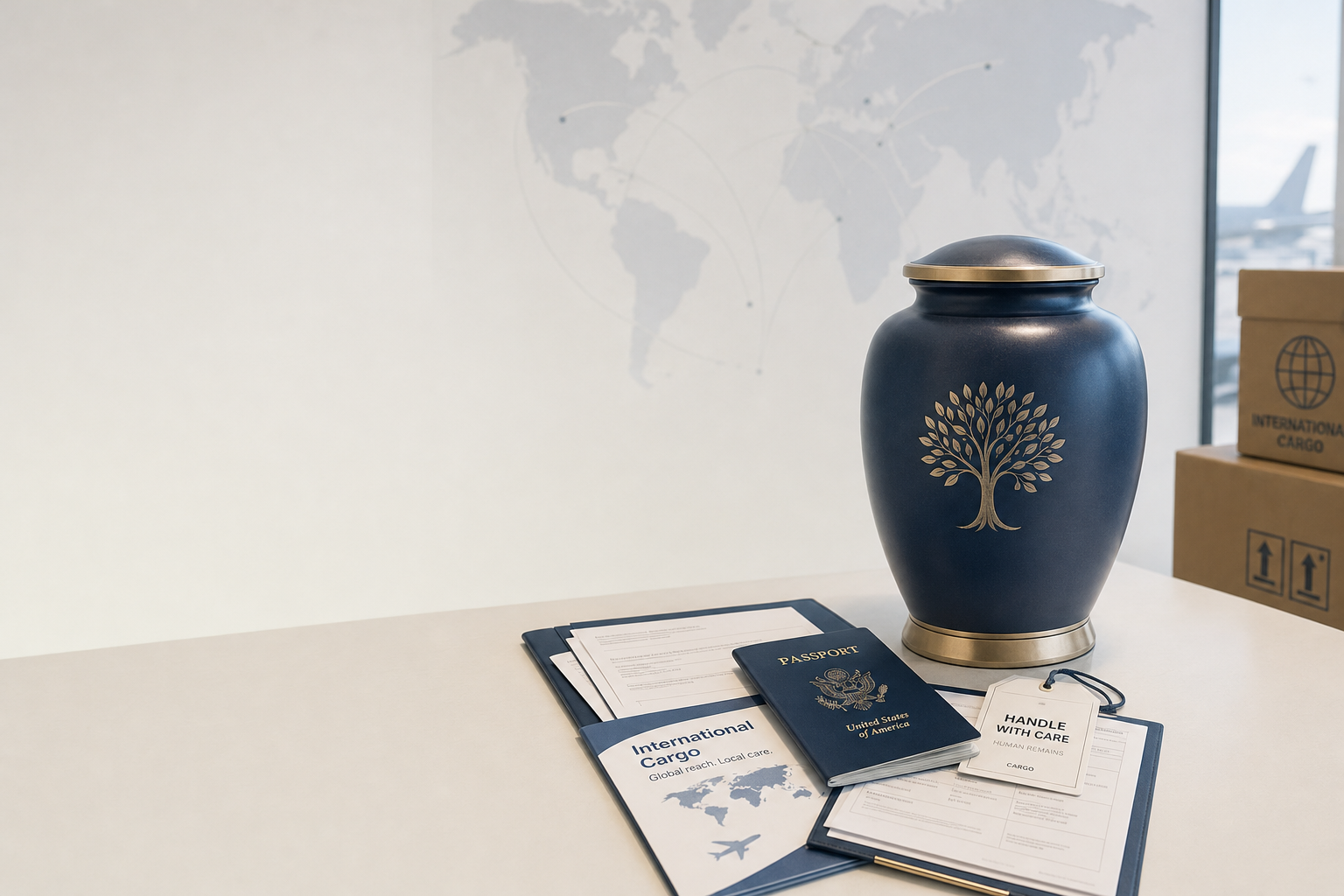
Document requirements vary by country and airline, but families commonly prepare several records before travel. These may include the original or certified copy of the death certificate, cremation certificate, cremation permit, certificate of disposition, and documents showing the identity of the person whose remains are being transported.
Depending on the route, authorities may also request:
- An export permit from the country where cremation occurred
- An import permit or authorization from the destination country
- A letter from a funeral home or crematory
- Certified translations into the destination country’s official language
- Authentication, notarization, legalization, or apostille of records
- Transit documentation for a connecting country
These documents are not automatically required on every route. The correct list must be confirmed with the relevant embassy, consulate, local authorities, airline, and receiving funeral professional.
Understand Customs and Entry Requirements
Cremated remains may be treated differently from non-cremated human remains. For example, current U.S. Centers for Disease Control and Prevention guidance states that fully cremated remains do not require a CDC import permit when entering the United States for burial, entombment, or cremation. The CDC also notes that its requirements do not replace other federal, state, local, airline, or foreign-country requirements. ([cdc.gov](https://www.cdc.gov/importation/human-remains/index.html?utm_source=openai))
U.S. Customs and Border Protection advises that requirements for ashes may differ from those for a body in a casket. Its guidance also indicates that additional documentation may still be requested by airlines or authorities for international shipments, including a death certificate and cremation permit. ([help.cbp.gov](https://www.help.cbp.gov/s/article/Article-1404?language=en_US&utm_source=openai))
Families traveling to another country should never assume that the destination follows U.S. rules. Some governments require prior authorization, consular documentation, specific packaging, or a local funeral director to receive the urn. Requirements can also change based on whether the ashes are being transported for burial, placement in a cemetery, scattering, or temporary custody.
Carry-On Travel Versus Professional Shipping
Carrying the urn personally can allow a family member to remain responsible for it throughout the journey. It may also reduce the number of handoffs. However, it places responsibility for airport screening, connections, and document presentation on the traveler.
Professional shipping may be preferable when:
- The family is not traveling on the same route
- The urn is too large or fragile for cabin baggage
- The destination requires cargo clearance
- Multiple permits or consular documents are needed
- The journey includes complex connections or border transfers
A funeral home or repatriation provider can coordinate with the crematory, airline, customs broker, and receiving funeral home. Families should ask who is responsible for each document, where the shipment will be released, and how tracking and delivery confirmation will be handled.
A Practical Planning Checklist
Begin planning as early as possible. A simple checklist can help prevent avoidable problems:
- Confirm the airline’s current cremated-remains policy
- Check the entry rules of the destination country
- Check requirements for every transit country
- Obtain certified copies of the death and cremation records
- Arrange translations or document authentication if required
- Use a container that can be screened
- Keep documents and contact details in both paper and digital form
- Allow extra time at the airport for security and customs procedures
- Confirm how the ashes will be received after arrival
Frequently Asked Questions
Can cremated remains be taken on an international flight?
Often, yes, but permission depends on the airline, airport screening requirements, and the laws of the countries involved. Confirm the policy with the operating airline before travel.
What type of urn is best for air travel?
An urn or temporary container made from a lightweight, inspection-friendly material such as wood or plastic is generally easier to screen. TSA recommends confirming that the container can pass through X-ray screening. ([tsa.gov](https://www.tsa.gov/travel/security-screening/whatcanibring/all?combine=Light&page=0&utm_source=openai))
Do I need a death certificate to travel with ashes?
It may be required by the airline, destination country, transit country, or customs authority. Even where a death certificate is not legally required for entry, carrying one with the cremation certificate can help explain the contents of the container.
Should cremated remains be placed in checked baggage?
Not necessarily. Some airlines do not allow ashes in checked baggage. Carry-on transportation may be permitted, but the airline’s specific rules should be confirmed before departure.
Can a funeral home help with international transportation?
Yes. A funeral home or international repatriation specialist may coordinate documents, airline arrangements, customs clearance, and delivery to a receiving funeral home. The exact services available depend on the route and local regulations.
Conclusion
Traveling internationally with cremated remains is possible, but respectful transportation depends on preparation. The urn must be suitable for screening, the airline must approve the method of travel, and the family must confirm the rules of every country along the route.
Because requirements differ, families should verify current information with the airline, the destination country’s embassy or consulate, customs authorities, and a qualified funeral professional. When the route is complex or time is limited, experienced coordination can help protect the family from unnecessary delays while ensuring the remains continue their journey with dignity.