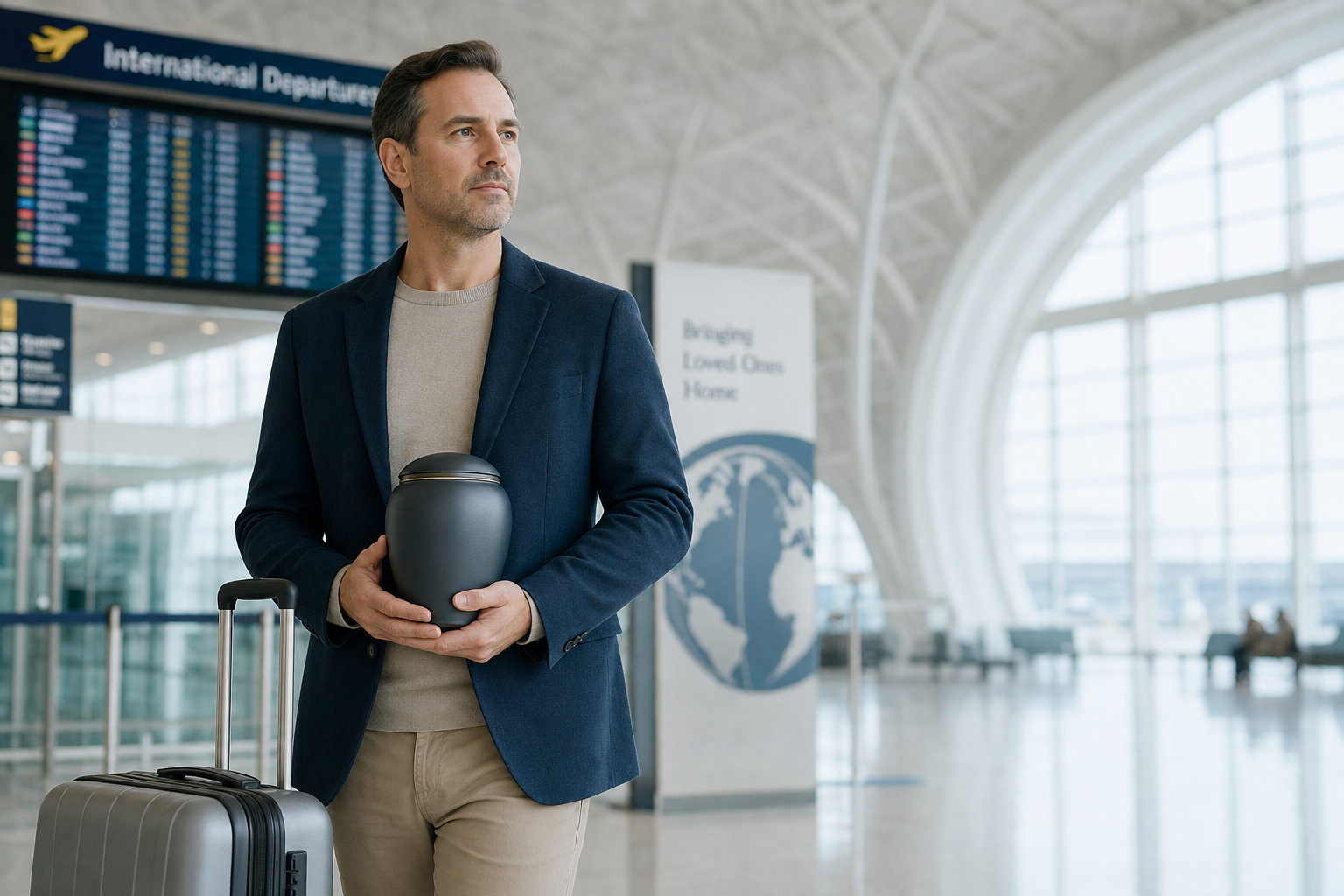
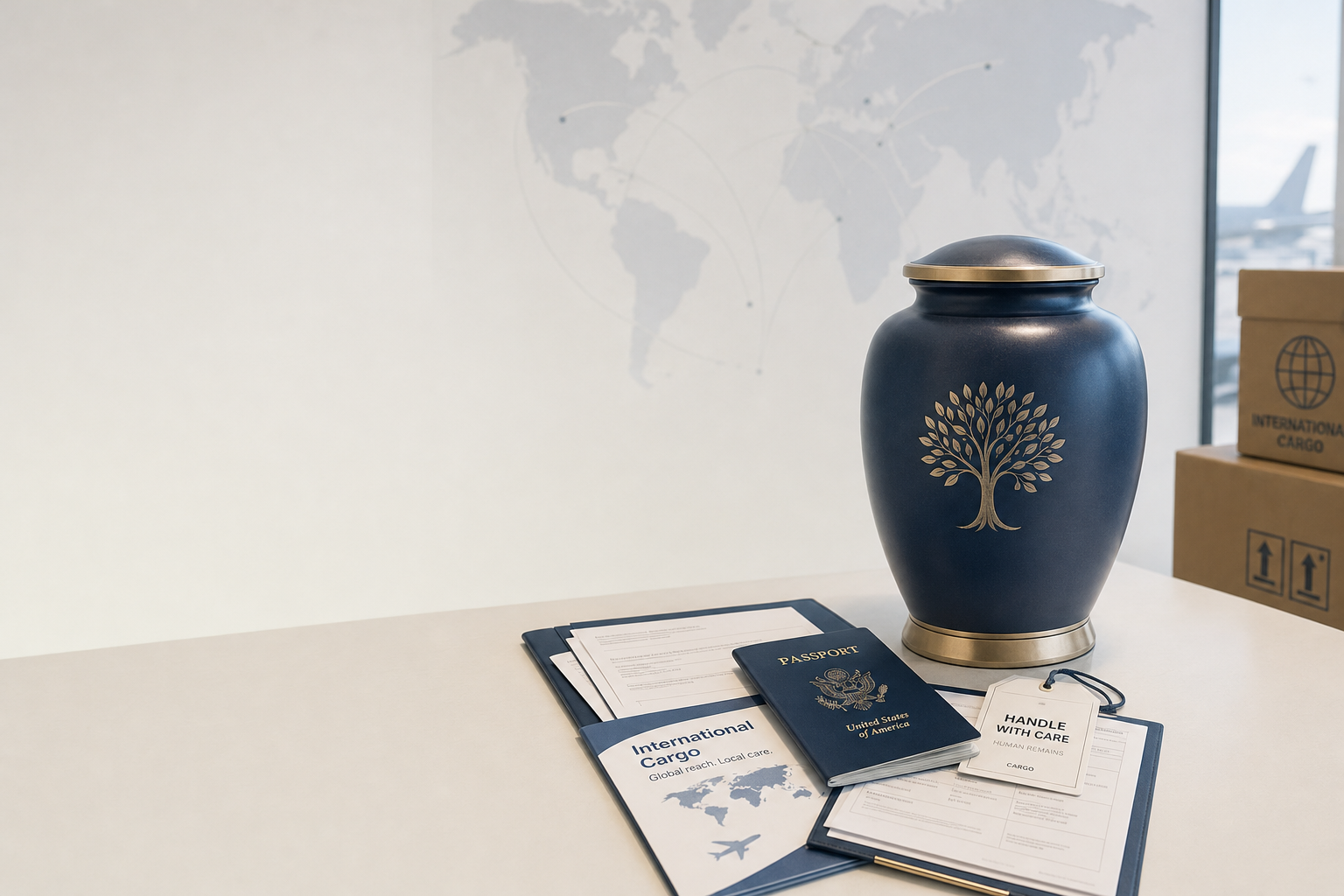
When a loved one is cremated in another country, bringing the cremated remains home can provide comfort and help families hold a funeral, memorial service, or burial according to their wishes. Although international transport of cremated remains is often less complex than transporting a body, it still involves important decisions and border requirements.
Families may need to coordinate with a crematory, funeral home, airline, customs authorities, embassy or consulate, and the authorities in the destination country. Requirements are not identical everywhere, so careful preparation is essential. The following guide explains the main considerations without assuming that one procedure applies to every international journey.
Why Cremated Remains May Be Easier to Transport
Cremation changes the practical requirements for international transportation. Cremated remains do not require the same type of casket, preservation arrangements, or leak-proof containment that may apply to non-cremated remains. For example, current U.S. Centers for Disease Control and Prevention guidance states that fully cremated remains do not require a CDC import permit when entering the United States for burial, entombment, or cremation.
However, “simpler” does not mean automatic. The country where the cremation occurred may require export documentation, while the destination country may have its own rules for importing ashes, registering the death, or completing a burial. Airlines can also impose specific conditions that differ between carriers and routes.
Documents Commonly Requested
The exact paperwork depends on the countries involved, the citizenship of the deceased, the purpose of transportation, and whether the family is traveling with the urn or using a funeral professional. Documents that may be requested include:
- Certified copy of the local death certificate
- Cremation certificate or certificate of cremation
- Certificate from the crematory identifying the cremated remains
- Permit or authorization for removal from the country of cremation
- Import permit or approval from the destination country, where applicable
- Translation of documents into the language required by local authorities
- Identification documents for the person carrying or receiving the urn
- Consular or embassy documentation in certain circumstances
Families should request several certified copies of key records before travel. Some authorities may require documents to be notarized, legalized, apostilled, or translated by an approved translator. These requirements vary, and an embassy or consulate can often clarify which documents are recognized in a particular country.
Choosing the Right Urn or Container
The container is an important part of a successful journey. Families should select an urn that is secure, appropriately sealed, and suitable for inspection. A temporary travel container may be useful when the permanent memorial urn is made from a material that could create screening difficulties.
For travelers departing from or traveling within the United States, the Transportation Security Administration advises using a temporary or permanent container made from a lighter material such as wood or plastic. If an urn is made from an opaque material that prevents officers from clearly seeing its contents on an X-ray image, it may not be permitted through the security checkpoint. TSA officers also state that they will not open the container, even at a passenger’s request.
Before leaving, families should confirm whether the crematory has placed the ashes in a sealed inner container and whether the exterior urn can be safely handled during screening. The urn should be packed to reduce the risk of damage, but it should remain accessible if documentation needs to be reviewed.
Traveling With Cremated Remains by Air
Some families choose to carry the urn as hand luggage, while others arrange transportation through a funeral home or specialist service. Carrying the urn personally may allow the family to remain close to the cremated remains, but it also means managing airport screening, connections, delays, and customs procedures.
Airline rules must be checked before booking. TSA notes that cremated remains may generally be carried in carry-on or checked baggage under its screening rules, but some airlines do not allow cremated remains in checked luggage. Airlines may also require advance notice, specific packaging, or additional documentation, particularly on international routes.
When contacting the airline, ask specific questions about:
- Whether the urn may travel in the cabin
- Whether the urn must fit within carry-on size limits
- Whether checked transport is permitted
- Whether the airline requires a cremation certificate
- How the urn should be labeled or packaged
- Whether connecting airports or partner airlines have separate requirements
Keep all original documents in a secure carry-on folder. It is also wise to carry copies separately and save digital scans in a secure location.
Customs and Destination-Country Requirements
International transportation involves both departure and arrival procedures. Customs officials may ask to see the death certificate, cremation certificate, identification, or documentation confirming that the container holds only cremated remains. Some countries allow travelers to enter with ashes after presenting basic records, while others require prior approval or a local funeral director to receive them.
The U.S. Department of State explains that burial or cremation arrangements must comply with both U.S. and foreign law. When a U.S. citizen dies abroad, consular officers can provide information and help families communicate with appropriate offices, but the Department of State does not pay to return remains or ashes to the United States.
Because rules can change and may depend on the specific destination, families should contact the destination country’s embassy or consulate before making travel arrangements. If the ashes are being shipped rather than carried, the receiving funeral home or licensed repatriation provider can help confirm the appropriate customs process.
Carrying the Urn Versus Using a Specialist
There is no single best option for every family. Carrying the urn may be appropriate when travel is straightforward and the family member is comfortable managing the process. Professional assistance may be preferable when there are multiple countries, connecting flights, language barriers, urgent timing, or complex documentation.
A specialist can help coordinate the crematory, document preparation, airline arrangements, customs clearance, and final delivery. Families should ask what services are included, whether destination-country partners are involved, and who is responsible for checking current government and airline requirements.
A Practical Preparation Checklist
Before traveling with or shipping cremated remains internationally, consider the following checklist:
- Confirm the laws of the country where the cremation occurred.
- Check the destination country’s import and burial requirements.
- Contact the airline before purchasing the ticket.
- Obtain certified copies of the death and cremation certificates.
- Arrange translations, notarizations, or legalizations if required.
- Choose an urn that can be screened without being opened.
- Keep original documents and copies with the traveler or shipment.
- Allow additional time for airport, customs, or consular review.
- Confirm how the urn will be received at the final destination.
Frequently Asked Questions
Can cremated remains be taken on an international flight?
In many cases, yes, but airline and destination-country rules vary. TSA permits cremated remains in carry-on and checked baggage under its screening guidance, while individual airlines may impose additional restrictions. Always confirm the policy with the operating airline before departure.
Does an urn need to be made of a particular material?
There is no universal material requirement for every country or airline. For travel through U.S. security checkpoints, a container that allows screening officers to see its contents on an X-ray is recommended. Wood or plastic temporary containers may be easier to screen than dense metal or stone urns.
What documents should accompany cremated remains?
The death certificate and cremation certificate are commonly requested, but additional permits, translations, or consular documents may be required. Requirements depend on the countries involved and the purpose of the transport.
Is a CDC permit needed to bring ashes into the United States?
Current CDC guidance states that a permit is not required for human remains that have already been fully cremated before importation. Other U.S. agencies, airlines, states, or foreign authorities may still have separate requirements.
Conclusion
International transport of cremated remains can be a meaningful way to bring a loved one home, but the process deserves the same care and attention as any other international funeral arrangement. The most important steps are confirming the rules for both countries, checking airline policies, preparing complete documentation, and choosing a container suitable for screening.
When requirements are uncertain or the journey involves multiple connections, professional guidance can reduce avoidable delays and help families focus on honoring their loved one. Because regulations and airline procedures differ, always verify current requirements with the relevant authorities before travel.
([cdc.gov](https://www.cdc.gov/importation/human-remains/index.html?utm_source=openai))