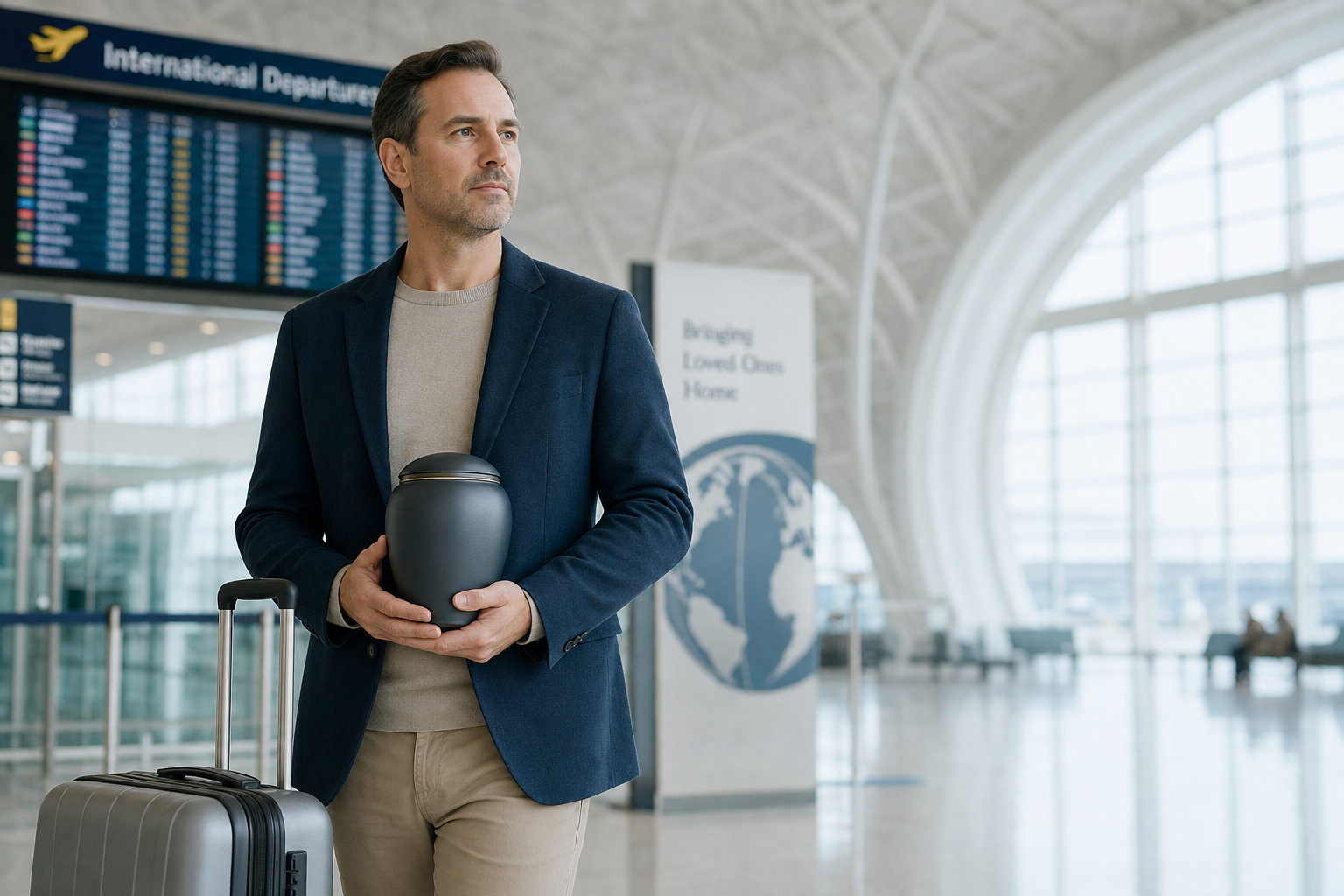
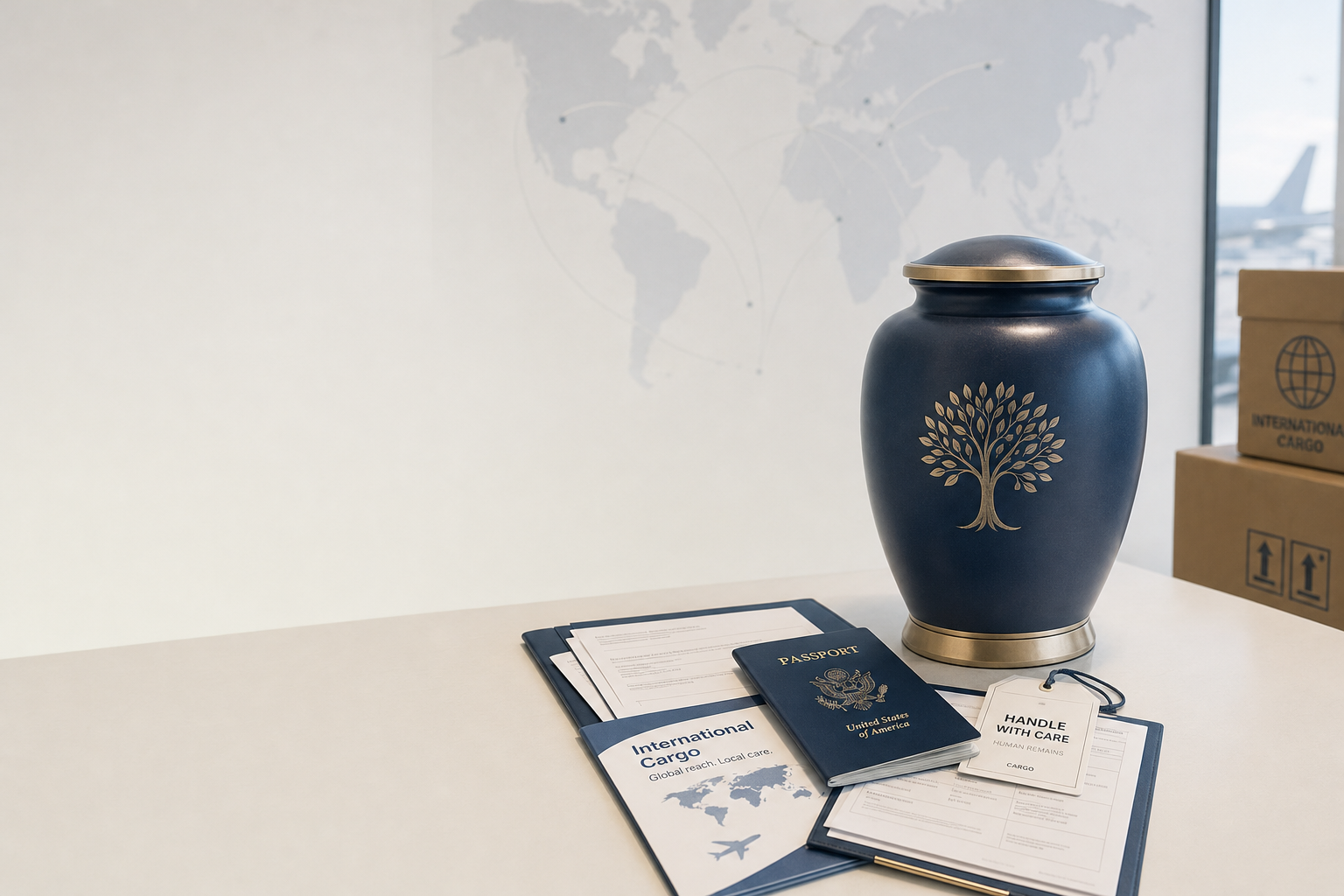
When a loved one is cremated in another country, bringing the cremated remains home can feel like a meaningful final step. It may also seem simpler than transporting a body. In practice, international travel with cremated remains still requires careful planning because airlines, airport security agencies, customs officials, and destination countries may have different rules.
The most important step is to confirm requirements before making travel arrangements. Policies can change, and a document or container accepted in one country may not be accepted in another. A funeral home, cremation provider, international repatriation specialist, airline, embassy, or consulate can help clarify what applies to the specific route.
Can cremated remains be taken on an international flight?
In many cases, cremated remains may travel either with a passenger or as air cargo. However, permission to carry an urn through airport security does not automatically mean the destination country will allow entry. The airline may also impose restrictions on carry-on or checked baggage.
The International Air Transport Association explains that there is no single universal international standard for the documentation and handling of human remains. Requirements may vary according to the departure country, transit points, destination country, airline, and method of transportation. ([iata.org](https://www.iata.org/en/publications/newsletters/iata-knowledge-hub/what-you-need-to-know-about-the-transportation-of-human-remains-by-air/?utm_source=openai))
For that reason, families should not rely only on general travel advice. Confirm the requirements directly with the operating airline and the authorities in the country where the remains will be received.
Documents commonly requested for international travel
The exact paperwork depends on the countries involved and the circumstances of the death. Cremated remains may be treated differently from non-cremated remains, but officials may still request documents that establish identity, lawful cremation, and permission to transport.
Documents that may be requested include:
- Certified copy of the death certificate
- Cremation certificate or certificate of cremation
- Certificate from the crematory or funeral home identifying the urn and remains
- Authorization from the person legally responsible for the arrangements
- Import, export, transit, or other permits required by the countries on the itinerary
- Certified translations or document authentication, when required
- Consular or embassy documentation in certain circumstances
This is not a universal checklist. Some countries may require additional approvals, while others may have specific forms, translations, seals, or time limits. The U.S. Department of State notes that the burial or cremation of a body must follow both U.S. and foreign law, and that arrangements can differ substantially based on local rules and practices. ([travel.state.gov](https://travel.state.gov/content/travel/en/international-travel/while-abroad/death-abroad1.htmlwhile-abroad.html?utm_source=openai))
Choosing an urn that can pass through security
One of the most practical considerations is the material used to make the urn. Airport screening equipment must be able to see through the container clearly. TSA guidance states that cremated remains are permitted in carry-on baggage with special instructions, but a container that produces an opaque image may not be allowed through the checkpoint. TSA also advises travelers to consider a temporary or permanent container made from a lighter material, such as wood or plastic. ([tsa.gov](https://www.tsa.gov/travel/security-screening/whatcanibring/all-list?pubDate=20250608&utm_source=openai))
Families should ask the crematory or funeral provider whether the urn is suitable for air travel. A common approach is to place the cremated remains in a secure inner container and carry that container inside a suitable travel urn. The permanent decorative urn can then be used after arrival if it is not appropriate for airport screening.
The container should be:
- Strong enough to protect the contents during handling
- Securely closed to prevent accidental opening
- Easy for security personnel to inspect without opening
- Clearly labeled with the deceased person’s name and relevant contact information
- Packaged according to the airline’s instructions
Carry-on or checked baggage?
When permitted by the airline, carrying cremated remains in hand luggage may allow the traveler to keep them nearby and avoid the risks associated with checked baggage delays or mishandling. TSA lists cremated remains as permitted in carry-on and checked baggage, but warns that some airlines do not allow them in checked bags. The final decision at a security checkpoint rests with the TSA officer. ([tsa.gov](https://www.tsa.gov/travel/security-screening/whatcanibring/all?combine=Light&page=0&utm_source=openai))
Airline policies are separate from TSA rules. Before traveling, contact every airline operating the journey, including codeshare carriers and airlines used for connecting flights. Ask about:
- Whether cremated remains may be carried in the cabin
- Whether advance notice or approval is required
- Container dimensions and weight limits
- Whether the urn must be accompanied by specific documents
- Rules for checked baggage or cargo transportation
- Requirements at transit airports
Request written confirmation when possible and keep it with the travel documents.
Preparing for airport security
Arrive early and keep the documents accessible. Tell the security officer discreetly that you are carrying cremated remains. The officer may need to examine the container using screening equipment, but TSA guidance says officers will not open the container, even if the passenger requests it. If the container cannot be screened clearly, it may not be permitted through the checkpoint. ([tsa.gov](https://www.tsa.gov/travel/security-screening/whatcanibring/all-list?pubDate=20250608&utm_source=openai))
Do not place the urn inside tightly packed luggage where it is difficult to remove. A separate protective case can provide cushioning while keeping the container easy to present. Avoid wrapping the urn in materials that prevent inspection or make it appear tampered with.
Checking destination-country requirements
International transport involves two separate questions: can the remains leave the country, and can they enter the destination country? A route may include additional requirements if there is a connection through a third country.
Before departure, confirm the rules with:
- The consulate or embassy of the destination country
- The relevant government authority in the country of cremation
- The funeral home or crematory
- The airline or air-cargo department
- A repatriation specialist familiar with the route
Requirements may depend on the deceased person’s nationality, place of death, cause of death, destination, and intended final disposition. U.S. CDC guidance states that fully cremated remains generally do not require a CDC import permit for final burial, entombment, or cremation in the United States, but other country-specific requirements may still apply. ([cdc.gov](https://www.cdc.gov/importation/human-remains/index.html?utm_source=openai))
Common mistakes families should avoid
Most problems are preventable when planning begins early. Families should avoid:
- Booking a flight before confirming airline and destination requirements
- Assuming a decorative metal or stone urn will pass security screening
- Relying on an uncertified photocopy when certified documents are required
- Ignoring transit-country rules
- Packing the urn where it cannot be easily removed for inspection
- Waiting until the airport to ask whether the remains may travel
If the process feels overwhelming, a funeral professional or international repatriation provider can coordinate with the crematory, airline, consulate, and receiving funeral home. This can be especially helpful when the family is managing grief, distance, language differences, or multiple jurisdictions.
Frequently Asked Questions
Can cremated remains go through airport security?
In the United States, TSA permits cremated remains in carry-on and checked baggage, subject to special instructions and screening. The container must be suitable for screening, and the airline may have stricter rules. ([tsa.gov](https://www.tsa.gov/travel/security-screening/whatcanibring/all-list?pubDate=20250608&utm_source=openai))
Should cremated remains be carried in the cabin?
If the airline permits it, carry-on transportation may help the traveler keep the urn close and avoid checked-baggage issues. Confirm the policy with the operating airline before traveling.
Do cremated remains require a death certificate?
Some authorities and airlines may request a death certificate, cremation certificate, or both. Requirements differ by country, so families should obtain and carry certified documents whenever advised by the relevant authorities.
Can a family ship cremated remains instead of carrying them?
In some situations, remains may be transported as cargo or through an authorized shipping service. The available options depend on the airline, destination country, packaging requirements, and documentation. A funeral professional can help compare the appropriate method.
Conclusion
Traveling internationally with cremated remains can be arranged, but it should never be treated as ordinary baggage. The urn, documents, airline policy, airport screening process, and destination-country rules all need to align.
Starting early gives the family time to obtain certified paperwork, select a security-friendly container, confirm every airline and transit point, and address unexpected requirements. With careful preparation and support from qualified professionals, the journey can be handled with dignity, respect, and fewer avoidable complications.