Introduction
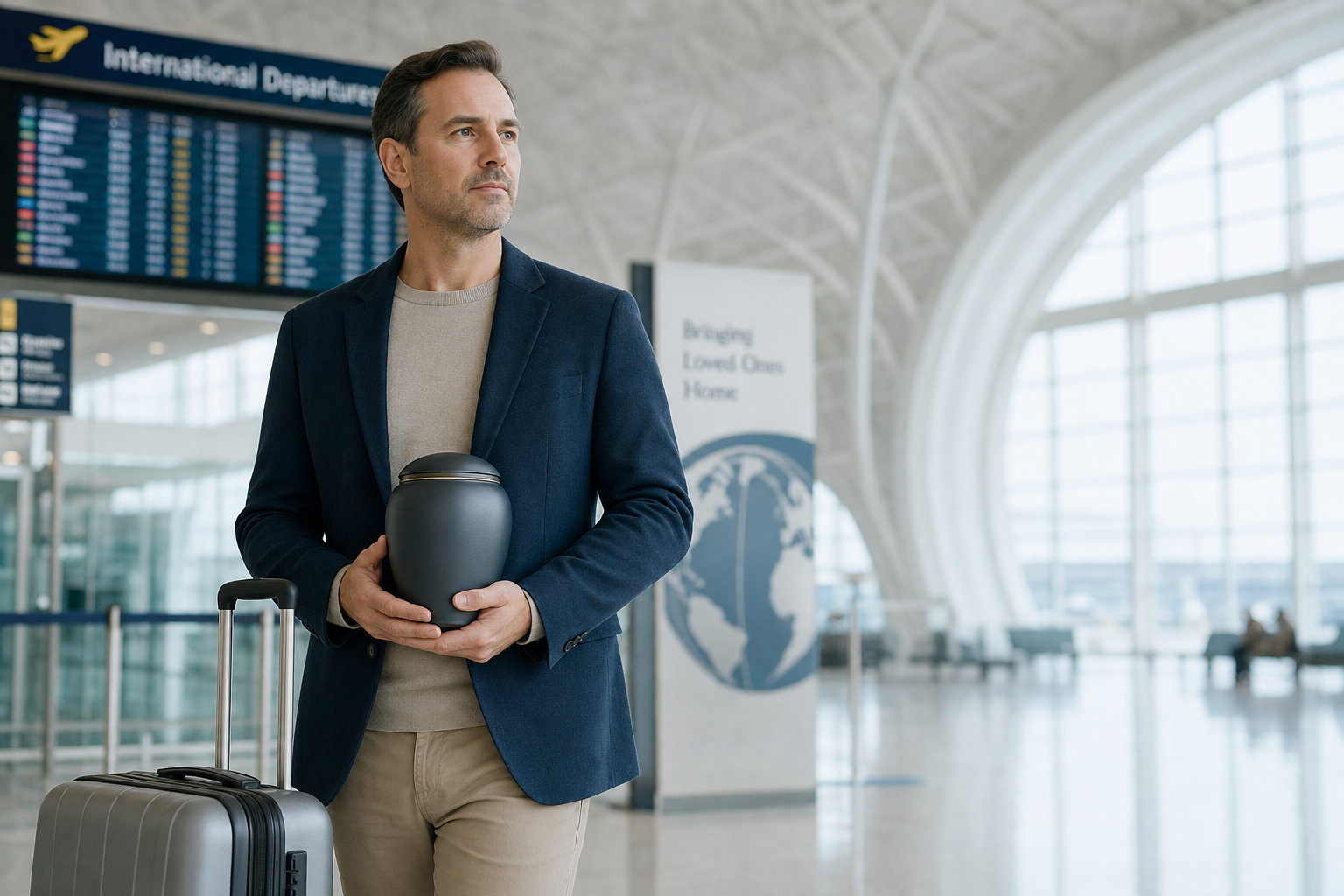
Traveling internationally with cremated remains can give families the opportunity to bring a loved one home, attend a funeral, or complete a religious and cultural ceremony in another country. Although cremated remains are often easier to transport than a body, international travel still involves important legal, airline, airport, and customs considerations.
Requirements are not identical everywhere. The country where the journey begins, the destination country, transit countries, airline, and airport may each have separate rules. Before making travel arrangements, families should confirm the requirements with the destination embassy or consulate, the airline, airport authorities, and the funeral professional handling the cremation or transportation. The following guidance offers a practical starting point, not a substitute for country-specific advice.
Understand the Difference Between Personal Travel and Shipment
There are generally two ways to move cremated remains internationally: a person may carry them during an international journey, or the remains may be shipped separately through an authorized service. These options are not interchangeable.
When a family member travels with the urn, the remains must pass through airport security and may need to be presented to airline staff or customs officials. When the urn is shipped, the package must meet postal or cargo rules, destination-country restrictions, customs requirements, and carrier conditions.
USPS states that international mailing of cremated remains is permitted only when the destination country allows it and when Priority Mail Express International service is available. USPS also requires a sealed, sift-proof funeral urn as the primary container and a designated outer package. ([pe.usps.com](https://pe.usps.com/text/pub52/pub52apxc_036.htm?utm_source=openai))
Check the Destination Country’s Requirements First
The most important early step is confirming what the destination country will accept. Some countries may require an import permit, translated documents, consular legalization, an apostille, or approval from a health or municipal authority. Others may have specific requirements for urn materials, certificates, or the person authorized to receive the remains.
Rules can also differ depending on whether the remains are carried by a passenger, shipped by post, or transported as cargo. A requirement that applies to a shipment may not apply in exactly the same way to hand-carried remains.
Ask the destination embassy or consulate and the receiving funeral home or cemetery for written instructions whenever possible. Confirm:
- Whether cremated remains may be imported.
- Which certificates, permits, or translations are required.
- Whether documents must be notarized, authenticated, legalized, or apostilled.
- Whether the urn must be sealed or made from a particular material.
- Who is permitted to receive the remains after arrival.
- Whether customs clearance must be completed before the traveler arrives.
Prepare the Essential Documents
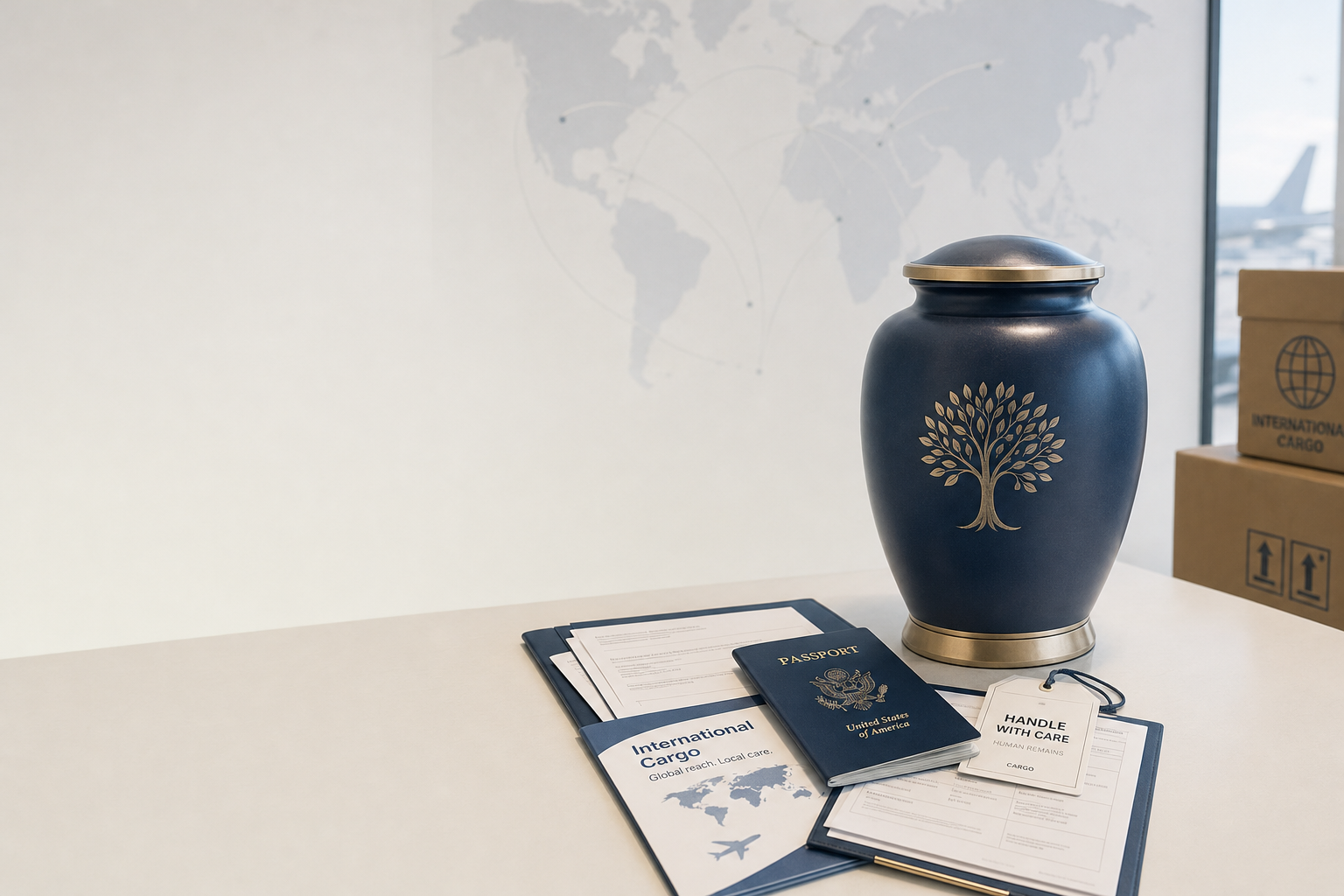
Document requirements vary, but families commonly need evidence identifying the deceased, confirming the cremation, and showing that the traveler or recipient is authorized to transport or receive the remains. Depending on the route, the documentation may include:
- A certified death certificate.
- A cremation certificate or statement from the crematory.
- A certificate of disposition or transit permit, when required.
- A copy of the traveler’s passport.
- Written authorization from the next of kin or legal representative, if applicable.
- Translation of documents into the official language of the destination country.
- Import permits or consular forms required by the destination.
Families should carry original documents when required, along with several paper and digital copies. Keep the documents accessible rather than packed inside checked luggage. If a government office or airline requests additional paperwork, having the full file available can help prevent avoidable delays.
Choose an Airport-Friendly Urn
Airport screening equipment must be able to identify the contents of the container. TSA advises travelers to use a temporary or permanent container made from a lighter material, such as wood or plastic, because containers that create an opaque image may not be allowed through the checkpoint. TSA officers also state that they will not open a cremation container, even when asked by a passenger. ([tsa.gov](https://www.tsa.gov/travel/security-screening/whatcanibring/all-list?pubDate=20250608&utm_source=openai))
This means a decorative metal, stone, or thick ceramic urn may be unsuitable for air travel. A practical approach is to transport the remains in a TSA-friendly temporary container and transfer them into a permanent urn after reaching the destination, if local rules allow.
The urn should be securely sealed and placed in a protective case that prevents movement and reduces the risk of damage. Avoid placing important documents inside the urn or in a location that cannot be accessed during inspection.
Confirm the Airline’s Policy Before Booking
Airline policies may be more restrictive than general airport security rules. TSA notes that some airlines do not allow cremated remains in checked baggage and recommends contacting the airline about its restrictions. ([tsa.gov](https://www.tsa.gov/travel/security-screening/whatcanibring/all-list?pubDate=20250608&utm_source=openai))
Before booking or shortly after booking, contact every airline on the itinerary, including codeshare carriers. Ask whether the urn may be carried in the cabin, whether it must fit under the seat or in an overhead compartment, and whether advance notification or special documentation is required.
Also consider transit airports. Even if the originating and destination countries permit the journey, a connecting country may impose separate customs or transit requirements. A route with fewer connections may reduce handling and simplify the documentation process.
What to Expect at Airport Security
At a U.S. airport, cremated remains may be permitted in both carry-on and checked baggage, subject to screening and airline restrictions. Travelers should place the urn where it can be removed easily from the carry-on bag and tell the TSA officer that it contains cremated remains.
The container may need to pass through X-ray screening. If the image cannot be cleared, TSA may not permit the urn through the checkpoint because officers do not open cremation containers. Arrive early, keep the bag organized, and allow additional time for screening. Carrying a cremation certificate or other supporting documentation may help explain the item, although documents do not replace the requirement for a screenable container.
Shipping Cremated Remains Instead of Carrying Them
Shipping may be appropriate when a family member cannot travel or when the receiving funeral home is coordinating the arrival. In the United States, USPS requires international cremated-remains mailings to use Priority Mail Express International when the destination country permits the shipment. The remains must be placed in a sealed, sift-proof funeral urn, cushioned to prevent movement, and packed in the required outer packaging. The customs declaration must accurately identify the contents, and the sender is responsible for obtaining required permissions and documents. ([pe.usps.com](https://pe.usps.com/text/pub52/pub52apxc_036.htm?utm_source=openai))
USPS updated its packaging guidance in 2025 to require the USPS-produced Cremated Remains Box for these shipments. Families should review the current instructions before mailing because service availability and destination restrictions can change. ([usps.com](https://www.usps.com/international/shipping-restrictions.htm?msockid=2e2a852a80dd67072fff936c81456699&utm_source=openai))
Common Mistakes to Avoid
- Booking a flight before confirming the airline’s cremated-remains policy.
- Using a permanent urn that cannot pass through X-ray screening.
- Assuming a death certificate alone satisfies the destination country’s requirements.
- Ignoring transit-country rules during a connecting itinerary.
- Packing original documents in checked baggage.
- Mailing the urn without confirming that the destination country accepts cremated remains.
- Leaving the process until the day before travel.
Frequently Asked Questions
Can I take cremated remains in my carry-on bag?
In many cases, cremated remains may be carried through airport security, but the container must be suitable for screening and the airline may impose additional restrictions. Confirm the policy with the airline before travel.
Can I place an urn in checked baggage?
Some airlines do not permit cremated remains in checked luggage. Even where checked transport is allowed, carrying the urn in the cabin may reduce the risk of loss or mishandling. Always follow the airline’s current policy.
Do I need a cremation certificate?
A cremation certificate is commonly requested, but the exact documentation depends on the countries involved and the travel method. Ask the destination authorities and airline for a complete list.
Can a metal urn pass through airport security?
It may not. TSA recommends a container made from a lighter material that can produce a clear X-ray image. A temporary travel container may be more practical than a heavy or opaque permanent urn. ([tsa.gov](https://www.tsa.gov/travel/security-screening/whatcanibring/all-list?pubDate=20250608&utm_source=openai))
Conclusion
Traveling internationally with cremated remains requires thoughtful preparation, but families can reduce uncertainty by treating the journey as a coordinated legal and logistical process. Confirm destination-country rules first, gather complete documents, choose a screenable urn, speak with every airline involved, and allow extra time at the airport.
When requirements feel difficult to interpret or the journey involves multiple countries, an experienced repatriation professional can help coordinate funeral homes, documentation, transportation, and receiving arrangements. Most importantly, families should verify every requirement with the relevant authorities before travel so their loved one’s final journey is handled respectfully and without preventable disruption.